
https://pagead2.googlesyndication.com/pagead/js/adsbygoogle.js?client=ca-pub-4000887400212447
Michaela Yearwood-Dan’s The Practice of Liberation at the Whitworth Gallery in Manchester is a deeply immersive exhibition exploring Blackness, queerness, femininity, colonial histories, faith, activism and the ongoing search for personal and collective freedom. As her first UK institutional exhibition, it is a significant moment in the career of an artist whose work continues to challenge, celebrate and inspire.
Planning a visit to Manchester? Explore places to stay and cultural experiences nearby
Book a Manchester City Walking Tour to discover the city’s rich history, culture and hidden stories through a more in-depth local experience.

The Kimpton Clocktower Hotel is an excellent choice for an overnight stay. Just over a mile away on Oxford Road, near the Whitworth Gallery, it combines grand Victorian architecture with contemporary boutique style in a beautifully restored historic building.

Oxford Road, Manchester
A First UK Institutional Exhibition at the Whitworth Gallery Manchester
Born in London in 1994, Michaela Yearwood-Dan has become one of the most exciting contemporary British artists working today. Over the past decade since graduating, she has exhibited internationally, developing a distinctive visual language across painting, works on paper, ceramics, murals and sound installations.
Her practice is centred around creating spaces of community, abundance and healing. Through vibrant colour, expressive forms and layered symbolism, Yearwood-Dan explores themes of Black identity, queer lives and culture, femininity, spirituality, politics and social change.
This summer, Manchester’s Whitworth Gallery presents The Practice of Liberation, a newly commissioned exhibition bringing together entirely new paintings, ceramic works and an immersive sound installation. Rather than simply displaying artworks, Yearwood-Dan creates an environment that encourages visitors to slow down, reflect and experience the exhibition as a complete sensory journey.
Explore books on Black artists, queer art and contemporary painting
Consider pre-ordering Another View: The Vibrant World of Contemporary Black Artists publishing on 5 November 2026, for a deeper exploration of the artists and ideas shaping contemporary Black art today.

The Vibrant World of Contemporary Black Artists
Queer Art: From Canvas to Club, and the Spaces Between celebrates the profound and enduring global impact of LGBTQIA+ artists, exploring how their creativity has shaped visual art, performance, music, culture and communities across generations.

From Canvas to Club, and the Spaces Between
Looking to deepen your understanding of how paintings are created? How Painting Happens (and Why It Matters) draws on decades of conversations with practising artists, with Martin Gayford offering an intimate exploration of the creative process, the significance of painting, and its enduring power in contemporary art.

(and Why It Matters)
Martin Gayford
An Immersive Experience of Painting, Ceramics and Sound
One of the most striking aspects of The Practice of Liberation is the way the exhibition combines different artistic forms. Large-scale paintings sit alongside ceramic sculptures and a bespoke musical composition by Alex Gruz, creating an atmosphere that feels almost ritualistic.
The exhibition space has a quiet, meditative quality. Positioned towards the back of the gallery, the location allows visitors to step away from the busier museum environment and enter a space designed for contemplation. It is not hidden because it is less important; instead, the setting enhances the feeling of entering a personal sanctuary.
Yearwood-Dan invites audiences not just to look at art, but to become immersed within it — surrounded by colour, sound, texture and ideas.

Michaela Yearwood‑Dan’s
The Practice of Liberation
Liberation, Colonialism and the Influence of the Catholic Church
At the heart of the exhibition is the theme of liberation. Yearwood-Dan examines how histories of colonialism, institutional religion and cultural identity have shaped personal and collective experiences.
The imagery of the Catholic Church plays an important role throughout the exhibition, reflecting the artist’s early relationship with Catholic traditions while also questioning the connections between religion, power and colonial histories. Symbols such as crosses, stained glass and devotional imagery are reimagined, creating a conversation between faith, oppression, resistance and freedom.
Rather than rejecting these symbols, Yearwood-Dan transforms them. They become signs of survival, healing and possibility — exploring how individuals and communities can reclaim narratives that have historically been controlled by institutions.

The Practice of Liberation
Art, Music, Politics and Personal Identity
Yearwood-Dan’s paintings are both personal and political. Her works often include handwritten passages, fragments of song lyrics and text from her own writing, creating layers of memory and meaning across the canvas.
Her influences stretch across literature, music and activism, including voices such as James Baldwin and Aretha Franklin. These cultural references connect struggles for racial justice, equality and liberation with ideas of love, joy and self-expression.
Her work celebrates Blackness, queerness and femininity while challenging systems that have excluded marginalised communities. Through vibrant colour and expressive mark-making, she creates spaces where identity is not only represented but celebrated.

Michaela Yearwood-Dan’s
The Practice of Liberation
Take the Weight Off My Shoulders (2026)
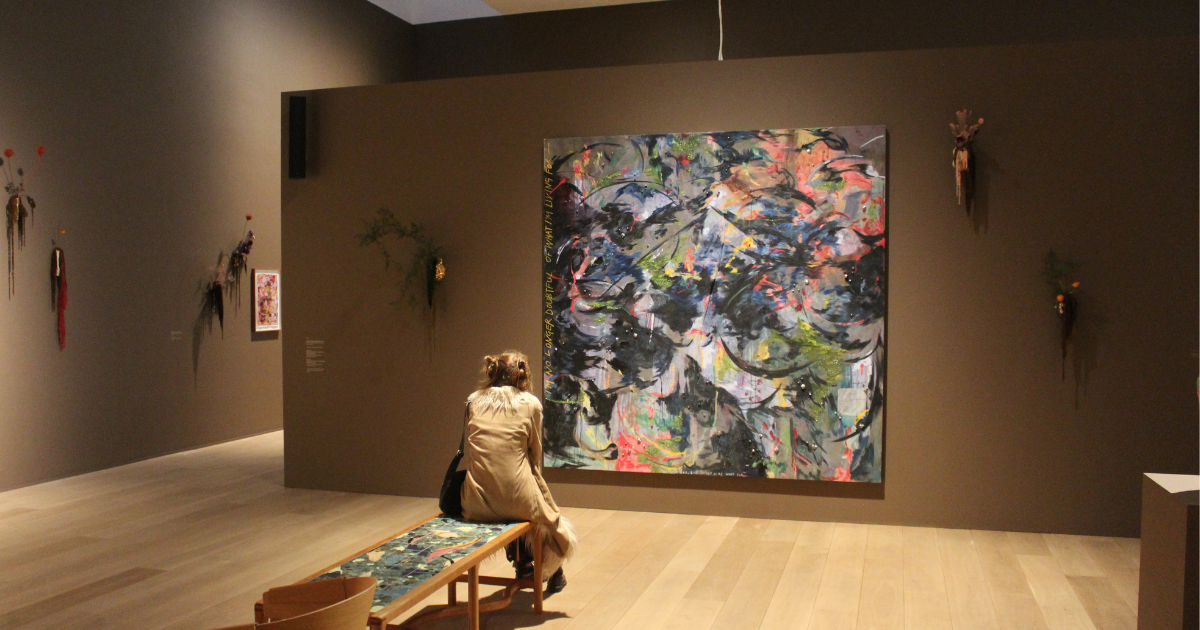
The artwork that stood out most during my visit was Take the Weight Off My Shoulders (2026).
Created using delicate voile fabric with a scar-like seam, and its textured surface combines traditional painting mediums with a sheet of tracing paper inscribed with a poem. The painting is a powerful abstract composition filled with rich purples, pinks and deep plum tones. These colours create a strong emotional connection to themes of queerness, identity and self-expression.
The surface is alive with movement. Layers of painted lines, marks and gestures flow across the work, creating a sense of energy and release. The painting feels as though it is carrying many different voices and experiences at once — personal memories, cultural histories and emotional journeys.
The accompanying text reflects a transformation from ideas of confrontation and conflict towards a deeper understanding of identity and freedom:
“I am no longer doubtful of what I am living for…”
The writing explores changing ideas of activism, power, femininity and self-realisation. It suggests that revolution can exist not only through political action, but also through embracing oneself fully and living authentically.
Inspired by Yearwood-Dan’s use of colour, texture and mixed media? Explore materials to experiment with your own creative practice.
Golden : Heavy Body Acrylic Paint is recommended to create strong textural surfaces similar to those used in Take the Weight Off My Shoulders.

Discover Sennelier Oil Pastels, renowned for their rich, creamy, lipstick-like texture and exceptional colour intensity. Available in both standard and giant sizes, they’re a favourite among artists seeking bold, expressive mark-making.

A Celebration of Love, Freedom and Collective Healing
What makes The Practice of Liberation so compelling is that it balances difficult histories with joy. The exhibition addresses colonialism, oppression and institutional power, but it is equally about celebration, love, creativity and possibility.
Yearwood-Dan’s use of botanical imagery, carnival influences, abstract forms and vibrant colour creates an atmosphere of abundance. Her work reminds us that liberation is not only about resisting systems of oppression — it is also about creating spaces where people can experience belonging, beauty and freedom.
Visiting Michaela Yearwood-Dan: The Practice of Liberation at the Whitworth Manchester
For anyone interested in contemporary art, identity, social history or immersive exhibitions, The Practice of Liberation is an essential visit.
Take your time with the exhibition. Listen to the music, absorb the colours, read the texts and allow the works to unfold slowly. This is not an exhibition to rush through; it is an experience designed for reflection.
Michaela Yearwood-Dan’s The Practice of Liberation at the Whitworth Gallery Manchester is a powerful reminder that art can be a place for questioning history, celebrating identity and imagining a more liberated future.

Michaela Yearwood‑Dan’s
Whitworth Gallery
This article contains affiliate links, which means I may earn a small commission if you click through and make a purchase — at no extra cost to you.
Leave a Reply