
https://pagead2.googlesyndication.com/pagead/js/adsbygoogle.js?client=ca-pub-4000887400212447
Political illustrations and caricatures offer a fascinating insight into how politicians are perceived by the public. They can celebrate, criticise, ridicule and challenge those in power, often communicating more through a single image than a lengthy political commentary.
Few recent political figures have experienced such an interesting transformation in their artistic representation as Andy Burnham. From the cool, almost album-cover-style portraits of his time as Mayor of Greater Manchester to increasingly exaggerated and humorous political cartoons during his rise to national leadership, illustrators have documented his changing fortunes.
Now, with his appearance on the front cover of The Big Issue in November 2026, the familiar cool aesthetic has returned, this time with a message about homelessness, social justice and political responsibility.

Stanley Chow
Stanley Chow: The iconic Andy Burnham portrait
One of the most recognisable artistic representations of Andy Burnham is the portrait by Manchester-based illustrator Stanley Chow.
The artwork has a distinctive, almost CD-cover-ready appearance. Presented in a square format, it features clean lines, simplified shapes and a striking red background. The colour references both the Labour Party and Manchester, while Burnham’s black T-shirt and glasses give him an instantly recognisable appearance.
It is a particularly cool depiction of Burnham, reflecting the image he cultivated as Mayor of Greater Manchester.
Burnham’s black T-shirt became something of a signature. Often combined with a smart-casual jacket, it presented a more relaxed, working-class identity than the traditional suits and tailoring associated with British political leaders.
Born in Liverpool and raised near Warrington, Burnham has strong connections with the North West. Manchester also played an important part in his teenage years, including his early experiences of going out in the city. Although he attended the University of Cambridge, he eventually returned to the North West and became Mayor of Greater Manchester in 2017.
The Stanley Chow portrait captures something of this Northern identity: confident, accessible and deliberately different from the traditional Westminster politician.
Originally created during the COVID-19 pandemic, the portrait was reproduced on merchandise, including mugs and prints, with profits supporting the Mayor of Greater Manchester’s charity.
Chow’s illustration subsequently took on a life of its own as Burnham’s political profile grew.

Conservative Party Conference
The controversy over Bottler Burnham
In autumn 2026, Stanley Chow’s illustration became the subject of a copyright controversy after the Conservative Party used it on water bottles distributed to journalists at its party conference.
The bottles featured the slogan ‘Bottler Burnham’ alongside ‘0% strength’, using Chow’s recognisable portrait to mock the Labour leader.
The artist objected to the unauthorised use of his work and threatened legal action. The Conservatives subsequently agreed to pay a £1,000 copyright fee and contribute towards his legal costs.
Chow, a lifelong Labour supporter, also objected to the image being used by Reform UK in political campaigning during the earlier Makerfield by-election.
The episode highlights an interesting issue surrounding political illustration. Artists may create images of politicians, but that does not mean political parties can freely appropriate their work to promote messages with which the artists disagree.
Political cartoons have long played an important role in British political debate, using humour, exaggeration and visual storytelling to challenge those in power. If you enjoy exploring the relationship between politics and illustration, take a look at Britain’s Best Political Cartoons 2026.

Political Cartoons 2026
Edited by Tim Benson
From cool portrait to political caricature
As Burnham’s relationship with Keir Starmer deteriorated and his ambitions for national leadership became increasingly apparent, his representation in political cartoons began to change.
The clean, carefully constructed Stanley Chow aesthetic gradually gave way to more exaggerated and comic depictions.
His glasses became more prominent, his ears appeared larger and his eyelashes seemed to grow progressively longer. The familiar black T-shirt remained, but the overall impression became less polished and increasingly humorous.
“A pair of eyelashes and a black T-shirt”
The increasingly prominent eyelashes also became a talking point in political commentary. In July, Kemi Badenoch reportedly reduced Burnham’s public image to little more than “a pair of eyelashes and a black T-shirt”, a cutting observation that captured how recognisable his carefully cultivated appearance had become. It was a reminder that his trademark look had become almost as much a part of his political identity as his policies.
Political cartoonists began using his physical appearance to communicate uncertainty, ambition and the challenges of his changing political position.

Ben Jennings
In July, Ben Jennings produced a BBC illustration showing Burnham in an almost childlike pose, scratching his head. The image suggested uncertainty and a lack of direction as questions about his political future intensified.
By August, following his election as Labour leader, The Times presented a different interpretation. Burnham appeared in holiday mode, lounging with his phone, giving the impression of someone who needed to abandon his relaxed surroundings and hurry into his new responsibilities.
The more serious, cool-looking Manchester mayor was increasingly becoming a subject for political comedy.

Ben Jennings
Ben Jennings and the King of the North
Burnham’s relationship with Manchester and the wider North West has remained central to his political identity.
His advocacy for regional devolution and his championing of northern interests have been important features of his public image.
The idea of establishing a northern presence for government and establishing Number 10 North, has also helped reinforce his reputation as a politician determined to challenge the dominance of Westminster.
In September, Ben Jennings depicted Burnham travelling north, with imagery positioning him as the King of the North.
The train journey reinforces his image as a politician connected with ordinary people and regional communities. However, the royal robes introduce another interpretation.
While they reflect his growing political status, they also suggest a degree of distance from the people he claims to represent.
It is a clever visual contradiction: the man of the people becoming a political king.
Want to find out more about Andy Burnham’s vision for Britain’s future? Explore Head North and his ambitious plans for change.

Andy Burnham
Steve Rotheram
Political satire, pickles and exaggerated features
By autumn, Burnham’s caricatures had become increasingly exaggerated.
His ears, glasses and eyelashes were more prominent, his face sometimes appeared gaunt, and his expressions became more cartoonish.
The humour was no longer simply about his appearance. His political difficulties and policy challenges were increasingly incorporated into the illustrations.

Ella Baron
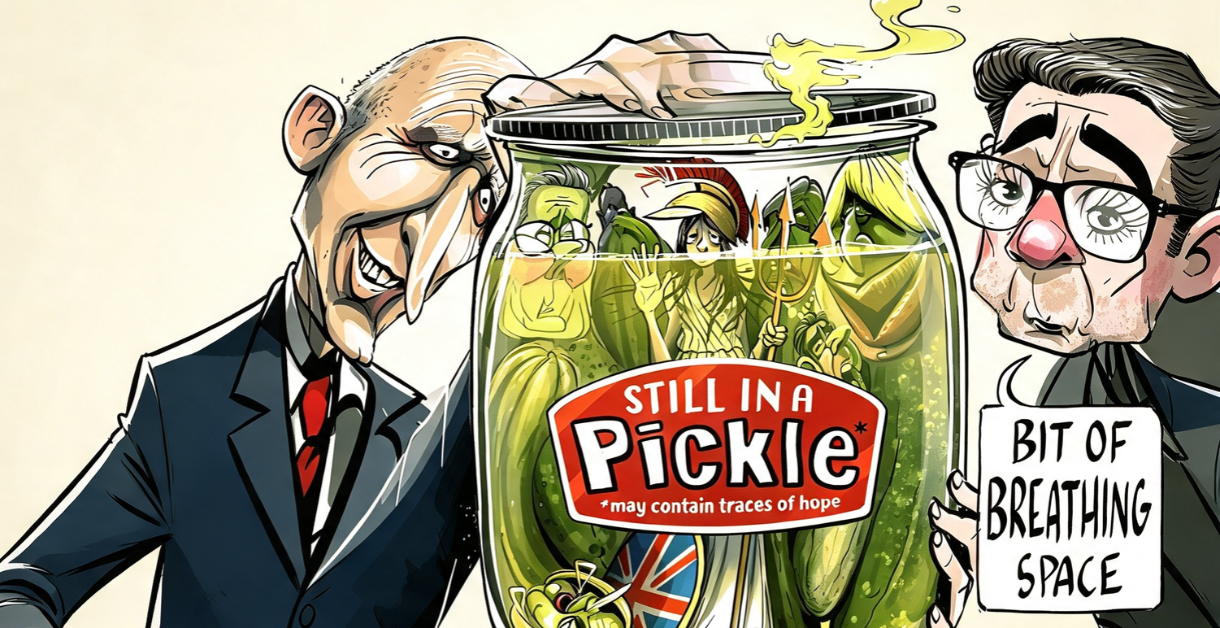
An autumn Budget cartoon by Ella Baron placed Burnham in a pickle, using the familiar expression to communicate the difficult political position in which he found himself.
The pickle jar became a visual reference to the Budget and proposed tariffs affecting imported products, including gherkins. Other politicians appeared around the jar, reinforcing the sense that Burnham was being surrounded by political problems.
The cartoon also includes the Chancellor, recognisable by his traditional black suit and red tie. However, his most striking feature is an exaggeratedly long nose. Although the Chancellor is not Jewish, this particular visual caricature has uncomfortable historical associations, recalling antisemitic Nazi propaganda of the 1930s and 1940s, in which Jewish people were grotesquely depicted with exaggerated noses as a means of dehumanisation.

Nazi-era satirical magazine
Whether intentional or not, the imagery raises questions about the historical language of political caricature and how familiar artistic conventions can carry troubling associations. The exaggerated features of the accompanying politicians added another layer of satire.
Other illustrations, including work published by Northern Agenda, explored his working-class roots through a very different setting.
One particularly humorous depiction placed Burnham in a cheap hotel room, surrounded by Greggs takeaway packaging and working late on his government’s ten-year plan.
The room’s colours referenced the bakery’s branding, while the familiar black T-shirt and increasingly exaggerated eyelashes remained.
Scattered papers suggested a politician attempting to make sense of competing priorities, from European relations to climate commitments and government policy.
The pastries provided another layer of wordplay. Terms such as ‘oven-ready’ and ‘flaky’ can describe both baked goods and political planning.
The implication was that Burnham’s political strategy might be just as likely to fall apart as the contents of his takeaway bag.
These illustrations demonstrate how political cartoonists use everyday objects, recognisable brands and physical exaggeration to make complicated political issues accessible and entertaining.

Graeme Bandeira’s
Shepard Fairey: Andy Burnham’s return to iconic political art
By November, however, the visual narrative had taken a considerably more positive turn.
The 16–22 November 2026 edition of The Big Issue features a striking new portrait of Andy Burnham by American street artist Shepard Fairey.

Shepard Fairey
Fairey is internationally recognised for his iconic 2008 HOPE portrait of Barack Obama, which became one of the defining images of Obama’s first presidential campaign.
His new Burnham portrait is entitled HOME and presents the Prime Minister wearing the distinctive red Big Issue vendor’s tabard.
It is a strikingly different image from the increasingly exaggerated political cartoons of recent months.
Burnham looks youthful again. His glasses are proportionate, his eyelashes have returned to normal length and the familiar black shirt is replaced by the red vendor’s clothing.
There is some grey in his hair, but it blends harmoniously with the background. His expression is warm and approachable.
Most importantly, this is not simply a portrait of a politician. It is an image with a social message.
The artwork recalls an occasion in 2023 when Burnham, then Mayor of Greater Manchester, put on a Big Issue tabard and sold copies of the magazine alongside Manchester vendor Colin outside HOME, a leading Arts venue.
The portrait connects that experience with his current political commitment to tackling homelessness and ending rough sleeping.
Fairey has described the artwork as a reminder of the promise politicians make and the importance of holding them accountable.
The word HOME is particularly significant. It transforms the image from a conventional political portrait into a visual statement about housing, poverty and social responsibility.
The cover also connects with Burnham’s pledge to ensure that people sleeping rough are offered a route off the streets by Christmas.
If you admire the graphic style of Shepard Fairey’s artwork, explore OBEY showcasing his distinctive approach to street art, political messaging and visual activism. His work demonstrates how bold graphic design can communicate powerful social and political ideas.

The Art of Shepard Fairey
Beyond the Streets: Political art and social responsibility
The Shepard Fairey portrait is not simply a magazine illustration. It is also part of the wider street culture exhibition BEYOND THE STREETS at London’s Saatchi Gallery, running from 11 November 2026 until 5 May 2027.
The exhibition celebrates six decades of street culture, art and activism, bringing together artists whose work has challenged conventional ideas about politics, identity and public space.
Fairey’s contribution is particularly appropriate given his history of combining graphic design, political messaging and social activism.
His Obama HOPE poster demonstrated how a single, visually powerful image could become an international political symbol.
With HOME, he has created another image that combines an instantly recognisable face with a simple but powerful message.
The red Big Issue tabard is central to its meaning. It represents the magazine’s longstanding work supporting people experiencing poverty and homelessness by providing an opportunity to earn an income through selling copies.
Since its launch in 1991, The Big Issue has become an important part of the UK’s social enterprise landscape.
The portrait therefore reflects more than Burnham’s personal political identity. It highlights the relationship between leadership, philanthropy and the responsibility to address social inequality.
The accompanying edition includes an exclusive interview with Burnham about homelessness and his pledge to tackle rough sleeping.
It also places the artwork within a wider discussion about the power of street culture and art to influence public debate.
Want to support people experiencing homelessness? The Socks Box is a thoughtful gift hamper combining cosy essentials and ethical treats while supporting fair trade, sustainability and homelessness relief. A gift that warms both hearts and feet!

The changing face of Andy Burnham in political illustration
Looking across these different representations, it is fascinating to see how the artistic image of Andy Burnham has evolved alongside his political career.
Stanley Chow’s original portrait established the cool, clean-lined aesthetic of the Manchester mayor: black T-shirt, glasses, red background and a confident, accessible appearance.
As Burnham’s political ambitions became more prominent, cartoonists began to challenge that image. Larger ears, exaggerated glasses, increasingly dramatic eyelashes and humorous expressions reflected the changing political mood.
Ben Jennings, Ella Baron and other illustrators used caricature to explore his ambitions, his relationship with the North and the challenges of political leadership.
Then came Shepard Fairey’s HOME portrait.
Here, the exaggerated features disappear. The familiar black shirt appears but under the red Big Issue tabard, and the subject is no longer simply a politician but a person associated with a wider social cause.
It is a warm, optimistic and carefully constructed image, although its message also carries a political challenge: promises about homelessness must translate into real change.
Political illustration is never simply about what somebody looks like. It is about how artists interpret their character, public image, policies and position in society.
Andy Burnham’s changing portraits provide an interesting visual record of his journey from Manchester mayor to Prime Minister.
And while the black T-shirt may remain part of his political identity, the most memorable image of his new leadership might just be the one in which he is wearing a red tabard and selling The Big Issue.
The question is whether the political promises represented by HOME will become as enduring as the artwork itself.

Nicola Jennings
This article contains affiliate links, which means I may earn a small commission if you click through and make a purchase — at no extra cost to you.
Leave a Reply