
https://pagead2.googlesyndication.com/pagead/js/adsbygoogle.js?client=ca-pub-4000887400212447
David Hockney’s paintings of California are among the most recognisable images in modern British art. Famous for their vibrant colours, swimming pools, sunlit interiors and depictions of the male body, they capture a distinctive vision of American life that fascinated the artist throughout the 1960s.
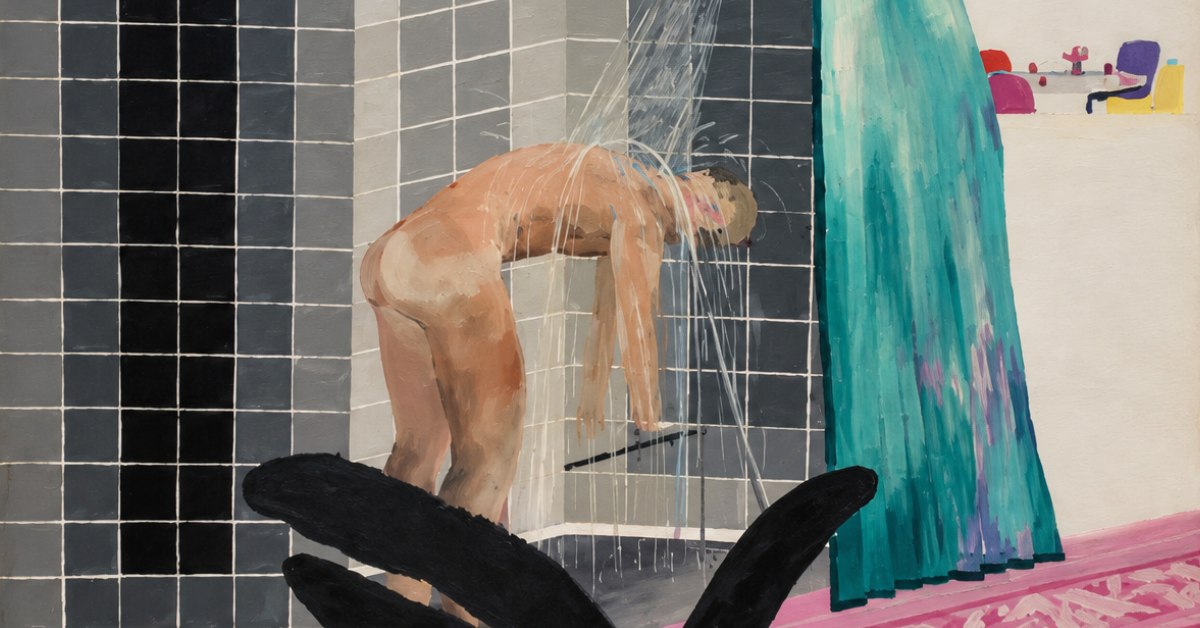
During a visit to Tate Modern in London, I came across Man in Shower in Beverly Hills, a work that brings together many of Hockney’s recurring interests: the movement of water, the male nude, domestic luxury and the relationship between everyday life and desire.
It was a great opportunity to explore Hockney’s artistic development while enjoying a day at one of London’s most impressive modern art galleries.
This book explores the themes in this article in greater depth, celebrating David Hockney’s six-decade career as a pioneer of Pop Art, colour and visual experimentation. From the Swinging Sixties in London to his iconic LA and California swimming pool series, Yorkshire landscapes, photographic collages and innovative iPad drawings, it reveals an artist constantly finding new ways to represent the world.

A Chronology. 45th Ed.
David Hockney’s Man in Shower in Beverly Hills
Painted in 1964, Man in Shower in Beverly Hills belongs to Hockney’s early exploration of California and its distinctive lifestyle. His first visit to Los Angeles in 1964 proved influential, introducing him to a world of bright sunshine, swimming pools, modern architecture and a different attitude towards domestic life.
The painting depicts a naked, athletic man bending beneath the shower, with water cascading over his body. The setting is a luxurious bathroom, a long way from the everyday British interiors Hockney had known growing up in Bradford.
The composition combines figurative painting with bold colours, simplified forms and abstract patterns. Greens and pinks contrast with the surrounding surfaces, while the falling water introduces movement into an otherwise carefully constructed interior.
Hockney was particularly interested in how water could be represented visually. Its transparency, movement and reflections presented an artistic challenge, one that would become central to his celebrated swimming-pool paintings.

David Hockney
Water, movement and the male body
Water became one of Hockney’s most enduring artistic themes. From the swimming pools of California to the showers and bathrooms of his early paintings, he repeatedly explored how water interacts with the human body and the surrounding architecture.
The shower scene is an everyday experience, but Hockney transforms it into something visually compelling. The falling water, the man’s posture and the bright bathroom surfaces make a familiar domestic routine feel almost theatrical.
The male figure is athletic and muscular, reflecting the idealised physique that attracted Hockney as an artist. There is an intimacy to the scene, but also a sense of looking at a carefully arranged image.
The painting invites questions about the relationship between the viewer and the figure. Is the man simply going about his daily routine, or is he also being presented as an object of desire?
This ambiguity is particularly interesting when considering Hockney’s identity as a gay man and his pioneering exploration of male beauty and same-sex desire at a time when homosexuality remained illegal in Britain.
This book explores the themes discussed in this article in greater depth, examining Hockney’s work alongside that of influential artists including Simeon Solomon, Clare Atwood, Ethel Sands, Duncan Grant and Francis Bacon. Celebrating queer creativity in Britain from the 1860s to the 1960s, it highlights a rich artistic heritage and the lasting impact of LGBTQ+ artists on British art history.

Clare Barlow
Why is there a plant in the foreground?
One of the more unusual details in Man in Shower in Beverly Hills is the dark plant-like form in the foreground.
The plant has often been discussed in connection with Hockney’s difficulties depicting feet. Rather than treating the detail as an elaborate symbolic statement, it is worth considering the practical decisions artists make when constructing a composition.
Whether concealing a challenging detail or introducing another shape into the arrangement, such choices can become part of a painting’s character. The foreground form also creates visual depth, drawing the eye back towards the shower and the figure.
It is a reminder that even an artist as accomplished as Hockney could approach painting with a combination of experimentation, ingenuity and humour.
From Bradford to California: The Making of David Hockney
David Hockney was born in Bradford in 1937 and studied at the Royal College of Art in London. By the early 1960s, he had become an important figure in the British Pop Art movement, attracting attention for his personality as well as his distinctive visual style.
His early success coincided with a growing interest in American popular culture. California offered new subjects and possibilities, and Hockney became fascinated by its architecture, swimming pools, bright light and changing social attitudes.
His work frequently explored everyday environments, from domestic interiors to gardens and landscapes. Yet these apparently ordinary subjects often carried more personal meanings, particularly in his depictions of relationships and sexuality.
As an openly gay artist working during a period of significant social restrictions, Hockney made space for male intimacy and desire in his art. His paintings helped broaden the representation of queer experiences within contemporary British and international art.
He also experimented with different techniques, including printmaking and acrylic painting, before eventually embracing digital drawing on the iPad. Across a career spanning more than six decades, he continually explored new ways of representing the world around him.
From the shower to the swimming pool

David Hockney
1966
Man in Shower in Beverly Hills anticipates themes that would become particularly famous in Hockney’s later paintings of California swimming pools.
His celebrated Peter Getting Out of Nick’s Pool, which won the John Moores Painting Prize in 1967, also combines the male body with moving water. Both works demonstrate his interest in the relationship between a figure and an architectural setting.
In these paintings, water is more than a background detail. It becomes an artistic subject in its own right, allowing Hockney to experiment with reflections, movement, colour and the contrast between solid forms and transparent surfaces.
The paintings also reflect the importance of California in Hockney’s personal and artistic life. The swimming pools, modern bathrooms and sunlit interiors represent a world that was visually different from Britain and offered new opportunities for exploring identity.
Although Hockney would later return repeatedly to the landscapes of Yorkshire, the Californian paintings remain among his best-known works.
A day at Tate Modern

London
Tate Modern is one of London’s leading destinations for modern and contemporary art, housed in the former Bankside Power Station on the south bank of the Thames.
The gallery’s vast interior, monumental spaces and constantly changing displays make it an enjoyable place to spend several hours. Even if you arrive with particular artworks in mind, there is always the possibility of discovering something unexpected.
During my visit, I enjoyed exploring the gallery’s range of art while making time to look more closely at Hockney’s work. Man in Shower in Beverly Hills offered a fascinating opportunity to consider the ideas behind his familiar imagery.
The gallery also provides plenty of facilities for visitors, including places to stop for coffee or lunch. Its location beside the Thames makes it easy to combine an art visit with a walk along the river, taking in the surrounding architecture and views across London.
Tate Modern is also a family-friendly destination, with activities and opportunities for younger visitors to engage with art. The sheer scale of the building can feel overwhelming at first, so it is worth allowing plenty of time rather than trying to see everything in one visit.
Although Man in Shower in Beverly Hills is displayed in the Studio, a free gallery space, you might like to discover more about Tate Modern and its collections. Book a place on the Tate Modern Official Discovery Tour for a deeper insight into the gallery and its art.

Official Discovery Tour
Finding your way around Tate Modern
Tate Modern is located on Bankside, within walking distance of Blackfriars, Southwark and London Bridge stations. The gallery’s displays change, so check the official Tate website before visiting to confirm whether Man in Shower in Beverly Hills is currently on view and where it is displayed.
The permanent collection includes free galleries, although special exhibitions may require a ticket.
Why David Hockney matters
Hockney’s appeal lies partly in his ability to make familiar subjects look extraordinary. A shower, a swimming pool or a sunlit room becomes an opportunity to explore colour, perception, movement and human relationships.
His depictions of male beauty also retain their historical importance. At a time when gay relationships were often excluded from mainstream cultural representation, Hockney made his own experiences and interests visible through his work.
His paintings are simultaneously personal and accessible. Their vivid colours and recognisable settings draw visitors in, while their treatment of identity, desire and the act of looking offers plenty to think about.
A visit to Tate Modern is an opportunity to appreciate these qualities at first hand. Man in Shower in Beverly Hills captures the early development of an artist who would go on to become one of Britain’s most influential cultural figures.
For anyone interested in modern art, LGBTQ+ art history or the relationship between art and everyday life, Hockney remains a fascinating artist to explore.
Planning an overnight stay in London, or thinking about extending your visit to the capital? Here are 3 great hotel options to consider for your stay.
Mercure London Bankside 203 meters from Tate Modern.

London Bankside
Premier Inn London Southwark 246 meters from Tate Modern.

London Southwark
Gresham Hotel Bloomsbury A short tube ride away, a great budget option with prices starting at £64.

Bloomsbury
This article contains affiliate links, which means I may earn a small commission if you click through and make a purchase — at no extra cost to you.
Leave a Reply