
https://pagead2.googlesyndication.com/pagead/js/adsbygoogle.js?client=ca-pub-4000887400212447
From a haunted mound at a skatepark to evangelical declarations and a curious blue creature, graffiti in High Wycombe reveals how people use public space to express identity, belief and belonging.
Graffiti is often discussed through the lens of Britain’s major cities. Bristol has its internationally recognised street art, London its vast and constantly changing walls, and Manchester its long history of urban expression. But the graffiti of High Wycombe, a Buckinghamshire town shaped by its proximity to London and its own traditions of industry and suburban expansion, offers a different perspective.
Here, the visual landscape unfolds across skateparks, brick walls and railway viaducts. Cartoon characters sit alongside signatures; religious declarations compete with existing images; and commissioned murals share their surroundings with unofficial interventions. The results are neither entirely spontaneous nor wholly planned. They are records of people making their presence felt.
Looking closely at three examples — a graffiti-covered mound at a skatepark, repeated Christian inscriptions and a large blue creature — reveals how street art and graffiti can transform ordinary structures into sites of humour, belief and local mythology.
Routledge Handbook of Graffiti and Street Art
Ideal for readers who want to explore the cultural and social significance of street art.

Graffiti and Street Art
Jeffrey Ian Ross
The Mound: Skatepark Graffiti and the Creation of Local Mythology
At High Wycombe skatepark, a rounded concrete mound has acquired an identity beyond its original purpose. Its surface carries the word “mound”, alongside a collection of marks and inscriptions that turn an otherwise unremarkable piece of skatepark infrastructure into a focus for collective attention.

High Wycombe Skate Park
One mark, a circle with a smaller protrusion, introduces a deliberately bodily, potentially sexualised element. Its meaning is ambiguous, but its crude humour sits comfortably within a tradition of graffiti that uses jokes, innuendo and irreverence to challenge the distinction between respectable public space and informal expression.
The surrounding writing extends the joke. References to “Cat” and declarations of affection for the mound suggest that the structure has become more than a physical obstacle. It is also a shared reference point, a feature around which a community of users can develop its own language.
The most evocative inscription is “I Love Haunted Mounds”. The addition of haunted shifts the mound from the realm of adolescent humour towards something resembling local folklore. An ordinary concrete form becomes a place with an imagined past, an uncertain personality and perhaps even supernatural powers.

Graffiti
High Wycombe Skate Park
This is not folklore in the traditional sense, passed down over generations. It is a miniature mythology emerging through contemporary youth culture. The writing invites those who encounter it to participate in the joke, whether or not they understand its origins.
The mound also complicates the distinction between graffiti and sculpture. Its shape determines how it is used and experienced, while the inscriptions alter how it is seen. Neither the concrete structure nor the writing tells the whole story: meaning develops through their interaction.
What emerges is an informal monument to the imagination of the people who use the space. Rather than commemorating an official event or celebrated individual, it records the capacity of young people to turn everyday surroundings into something of their own.
Christianity and Graffiti: Faith Written on the Wall

Viaduct Skate Park
High Wycombe
Elsewhere in High Wycombe, repeated Christian inscriptions introduce a different kind of intervention. Messages including “The Nation Needs Jesus!”, “Jesus Christ Is Lord!”, “Jesus Loves You” and the biblical reference “John 3:16” appear across walls already occupied by graffiti and other imagery.
Unlike a commissioned mural, these declarations have the immediacy of personal testimony. Their handwritten appearance and repetition suggest an insistence on making faith visible in a shared environment.
“The Nation Needs Jesus” is particularly revealing. The message moves beyond an individual’s religious convictions to make a claim about society as a whole. It presents Christianity not simply as a personal source of comfort or guidance, but as something the writer believes the wider public needs to hear.
The effect is difficult to separate from the act of repetition itself. A single inscription might be read as a passing expression of belief; numerous declarations create a more persistent presence. The wall becomes a site of public evangelism, where religious conviction competes for attention with the visual language already established there.
When religious graffiti meets street art

Viaduct Skate Park
High Wycombe
One of the most striking encounters occurs where Christian messages appear on and around a large, dark, wolf-like creature. Its horns, colouring and aggressive profile might evoke demonic imagery, although the original artist’s intentions cannot be established from the image alone.
Placed alongside this figure, the declarations of faith acquire an additional resonance. “Jesus Loves You” and “Jesus Christ Is Lord” can be read as a response to the creature, creating the impression of a visual confrontation between opposing symbolic worlds.
Whether or not the person writing the messages intended this dialogue, the juxtaposition encourages it. The creature and the inscriptions occupy the same surface but communicate through different visual languages: one through an expressive, imaginative figure, the other through direct statements of religious conviction.
The wall becomes a record of competing claims to meaning. An image is made, another person responds, and the surface changes again. The process resembles a conversation in which the participants do not necessarily know one another and may never meet.
This is one of graffiti’s defining characteristics. Unlike an artwork displayed in a gallery, where the artist can control its immediate context, graffiti remains vulnerable to interruption, reinterpretation and overpainting. Its meaning is never entirely fixed.
In High Wycombe, these religious inscriptions demonstrate how public walls can become spaces of testimony, disagreement and encounter — places where private belief is made visible to strangers.
When Religion and Morals Become OCD
An insightful resource for anyone who has recognised signs of religious OCD and wants to understand the subject further. This book explores scrupulosity and moral perfectionism, often misunderstood forms of OCD involving religious or ethical obsessions, covering their symptoms, causes, diagnosis and treatment. Written by an experienced therapist, it offers a deeper understanding of this often-overlooked condition.

Leslie J. Shapiro
The Blue Creature: Character, Identity and the Changing Wall
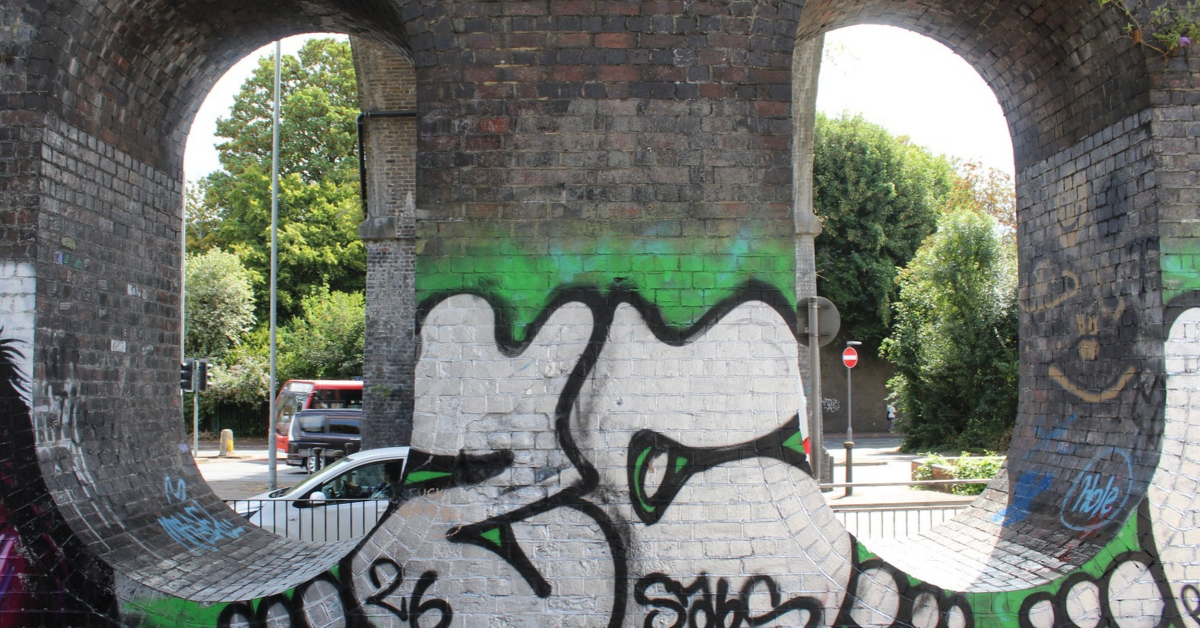
Among the more memorable examples of street art in High Wycombe is a large blue creature painted on a brick wall. Its oversized eye, elongated snout and exaggerated features give it the appearance of a cartoon character, mythical animal or friendly alien.
Standing apart from the surrounding tags and stylised lettering, the figure communicates through character rather than typography. Its expression and silhouette offer an immediate point of recognition, even to passers-by unfamiliar with graffiti conventions.

Viaduct Skate Park
High Wycombe
There is something almost illustrative about its appearance, recalling the expressive energy of children’s book illustration while retaining the informality of street art. It occupies an uncertain territory between a recognisable character and an invented creature.
The figure’s bodily details and clothing introduce further questions about how identity is represented. Its profile includes an Adam’s apple and a blouse-like garment, details that may invite interpretations around gender presentation. It would be tempting to identify the figure as a representation of a transgender woman, but without knowing the artist’s intentions, that remains one possible reading rather than an established meaning.
This ambiguity is part of the image’s interest. The creature resists a straightforward classification, inviting viewers to bring their own associations to its appearance. In a visual culture often dominated by instantly recognisable symbols, its uncertain identity leaves room for interpretation.
Graffiti as a living archive
The blue creature is also inseparable from the wall on which it appears. White spray-painted tags, green markings crossing its head, weathering and fading all testify to the surface’s continued use. Vegetation emerging from cracks in the brickwork adds another layer of change.
These interventions might initially appear to diminish the original image. Yet they also reveal something about its existence in public space. The creature is not preserved behind glass or protected from the elements. It remains exposed to the actions of other people and the gradual deterioration of the building itself.
The wall functions as a kind of living archive, recording successive acts of occupation. Some marks obscure others; some coexist; some survive in fragments. The original artwork becomes part of a larger visual history that no single artist can entirely control.
This is one of the differences between graffiti and the more carefully managed forms of public art commissioned by councils, developers or cultural organisations. A commissioned mural may have an agreed design, a defined lifespan and a maintenance plan. An unofficial image enters a more uncertain process, where its future depends on the choices of others.
The blue creature’s significance lies partly in this survival. It has become embedded in the material life of the wall, acquiring meaning through its continued presence amid change.
Liquitex : Professional Acrylic Spray Paint
Highly pigmented, water-based acrylic spray paint designed for interior and exterior use, offering a durable, permanent finish. Ideal for exploring mural techniques, experimenting with colour and creating artwork in designated spaces.

Brilliant Blue
Commissioned Street Art and Informal Graffiti in High Wycombe

Frogmore, High Wycombe
Wycombe Arts Centre and Aspire
The town’s wider urban landscape includes colourful murals featuring animals, flowers, wildlife and community themes. These works sit alongside tags, handwritten messages and more spontaneous interventions, creating an environment in which official and unofficial forms of visual expression overlap.
The distinction matters, but it is not always as clear-cut as it first appears. Commissioned street art generally operates within an agreed framework of permission, design and public expectations. Graffiti can be more immediate and less predictable, emerging from individual decisions about where and how to make a mark.
Yet both can change how a place is experienced. A mural may introduce colour to an overlooked wall, while a small inscription can transform a familiar structure into a local landmark. Both depend on their relationship with the surrounding architecture and the people who encounter them.
Viaducts and other transitional spaces are particularly revealing. Often treated as infrastructure rather than destinations, they can become informal galleries where different styles, intentions and levels of artistic ambition exist side by side.
The result is not necessarily a coherent visual scheme. Instead, it is a landscape shaped by competing ideas about what public space is for, who has the right to alter it and whose expression deserves to remain visible.
Capture street art with confidence using this practical guide to urban photography. Photographer Brian Lloyd Duckett shares expert techniques, composition tips and hands-on advice to help you move beyond luck and capture compelling street scenes.

Brian Lloyd Duckett
What Does Graffiti Reveal About High Wycombe?
The mound, the Christian inscriptions and the blue creature offer three different ways of understanding graffiti in High Wycombe.
At the skatepark, humour and repetition create a shared mythology around an ordinary structure. On the religiously inscribed walls, faith becomes a public declaration, sometimes appearing to challenge the imagery already there. The blue creature, meanwhile, raises questions about character, identity and the uncertain life of an artwork once it enters the public realm.
None of these examples needs to be monumental to be culturally revealing. Their importance lies in their relationship with the spaces they occupy and the people who use them.
Graffiti is often judged according to whether it is authorised, attractive or destructive. Those questions matter, particularly when considering the maintenance of shared spaces and the preservation of existing artworks. But they do not exhaust what graffiti can tell us.
The walls of High Wycombe also reveal how people create meaning outside formal cultural institutions. A concrete mound becomes a legend; a religious message becomes a public testimony; a blue creature becomes a character whose identity remains open to interpretation.
These marks may be temporary, overwritten or erased. For as long as they remain visible, however, they offer a glimpse of the town’s changing social and cultural life — a reminder that public space is never simply an empty backdrop. It is continually being claimed, interpreted and rewritten by the people who inhabit it.

High Wycombe
The photographs in this article were taken with a Canon EOS 2000D DSLR Camera.

EF-S 18-55 mm f/3.5-5.6 III Lens
This article contains affiliate links, which means I may earn a small commission if you click through and make a purchase — at no extra cost to you.


Leave a Reply