
https://pagead2.googlesyndication.com/pagead/js/adsbygoogle.js?client=ca-pub-4000887400212447
Tucked between Crosby Beach and Hightown lies one of Merseyside’s most overlooked historical sites: Fort Crosby. Part ruin, part underground gallery, this early 20th-century coastal defence structure has quietly evolved into a compelling intersection of history, decay and contemporary urban art.
A head mounted torch light is great for exploring abandoned spaces like Fort Crosby.

A Hidden Relic of Britain’s Coastal Defences
Originally constructed to protect Liverpool and the Mersey Estuary from naval and aerial attacks, Fort Crosby formed part of a broader network of artillery batteries and defensive positions. During the First World War, it served as headquarters for the Lancashire and Cheshire Heavy Brigade of the Royal Artillery. By the outbreak of the Second World War, the site was reactivated, with heavy gun emplacements, observation posts, signal stations and barracks reinforcing its strategic importance.
Although it never saw direct combat, its role as a defensive stronghold was crucial. The wider Liverpool coastline became a key line of defence during the Blitz, when thousands of lives were lost and rubble from bombed areas was later dumped along the shore—earning parts of the coastline the nickname “Blitz Beach.”
Today, much of the structure remains: a network of corridors, low-ceilinged rooms and partially buried walkways. Yet time, weather and neglect have transformed the bunker into something altogether different.
Brown Crosshunt waterproof hunting boots are well suited for navigating uneven terrain like Fort Crosby—fully waterproof and built for versatility in challenging conditions.

Brown Crosshunt
From Military Stronghold to Urban Canvas
Entering Fort Crosby now is to step into a layered environment of crumbling concrete and accumulated expression. The long central corridor—dim, narrow and difficult to stand upright in—reveals walls saturated with graffiti. Over years, artists have returned repeatedly, repainting, overwriting and reshaping the space.
This is not curated street art but an evolving palimpsest: tags, symbols and fragments of text stacked over one another. Names like “AJ13” and “EDM” appear frequently, functioning less as messages and more as assertions of presence—markers of identity within graffiti subculture. These quick, spray-painted signatures reflect the ritual of tagging: speed, anonymity and territoriality.
The environment itself shapes the work. Hidden from public view, with little surveillance, the bunker operates as an informal creative zone—a place where experimentation thrives without the pressures of visibility or permanence.

Fort Crosby
Symbols in the Dark: Light, Warmth and Memory
Among the more expressive pieces is a vivid red-and-yellow flame painted near an entrance wall. Resembling a candle, it introduces a rare sense of symbolism into an otherwise fragmented visual field. In a bunker originally defined by darkness and uncertainty, the image evokes warmth, light and survival.
Nearby, a sunburst motif accompanied by the faint phrase “GOOD TIMES” offers a contrasting emotional tone. Bright and optimistic, it feels almost ironic against the debris-strewn floor—plastic bags, drink cans and remnants of everyday consumption. Whether nostalgic or defiant, it represents a small act of human warmth within a neglected space.

Fort Crosby
Icons of Fragility: Amy Winehouse and Marilyn Monroe
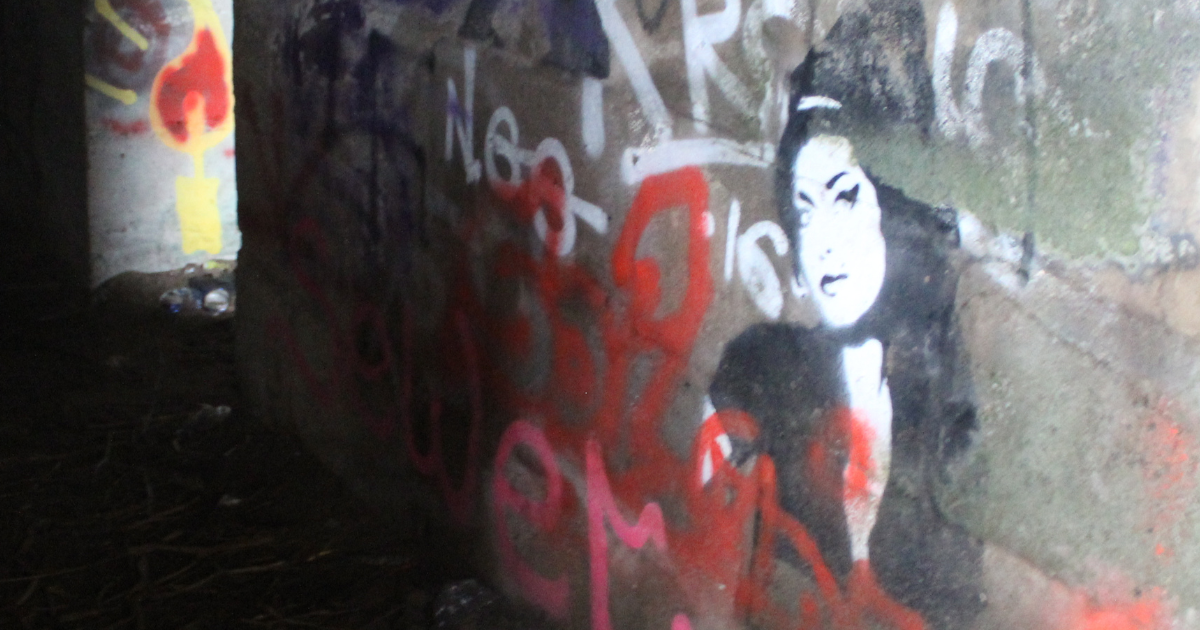
More striking still are the stencilled portraits of Amy Winehouse and Marilyn Monroe. In a setting dominated by rough tagging, these works stand apart—carefully executed, visually coherent and notably untouched by other writers.
Both figures, cultural icons who died young, carry a particular resonance in a site tied to wartime anxiety and mortality. Their presence introduces a subtle dialogue between past and present: the imminent threat once faced within these walls mirrored by the tragic brevity of their lives.
The portraits rely on stencil techniques—clean, repeatable and precise—contrasting sharply with the surrounding chaos. This approach aligns them more closely with street art traditions than with tagging culture. The influence of Andy Warhol is evident, particularly in the stylised treatment of celebrity and the merging of popular culture with bold graphic form.
Accompanying the Monroe portrait is the phrase “Normal is Boring,” a familiar countercultural slogan. Within this context, it resonates on multiple levels: a rejection of conformity, a nod to Monroe’s complex life, and perhaps even a reflection of the bunker itself—an abnormal space repurposed through creativity.

Fort Crosby
Graffiti as Dialogue, Not Decoration
While much of the graffiti appears to be the work of teenage male writers—focused on tagging and territorial marking—the inclusion of iconic figures and symbolic imagery broadens its appeal. These elements suggest that even within informal, unsanctioned environments, hierarchies of value emerge. Certain works are respected, preserved and left untouched.
Fort Crosby’s interior becomes, in effect, a collaborative and evolving dialogue. Each layer of paint represents a moment in time, a different author, a new intention. Some marks are purely functional—quick signatures of presence—while others strive for aesthetic or emotional impact.
Want to capture urban art like a professional? Check out this photography course from Upskillist.

Upskillist
A Fragile Future
Despite its historical and cultural significance, the site is not protected as a formal gallery or heritage attraction. The structure is partially buried in places, scattered with debris and potentially hazardous materials. Its future remains uncertain: redevelopment could erase both the wartime architecture and the accumulated artwork without record.
Yet this impermanence is also central to its meaning. The graffiti, like the bunker itself, exists in a state of transition—subject to decay, renewal and eventual disappearance.

Fort Crosby
Where History and Subculture Converge
Fort Crosby stands as a rare convergence of military history and contemporary urban culture. Once built to defend against external threats, it now hosts an internal dialogue of identity, memory and expression.
In its dark corridors, the past is not preserved in silence but reinterpreted through spray paint and stencil. The result is neither purely historical site nor conventional art space, but something more complex: a living archive of human presence, shaped as much by today’s anonymous artists as by the soldiers who once occupied it.
Rafael Schacter’s Monumental Graffiti informed much of the thinking behind this article. If you’re interested in exploring these ideas in greater depth, it’s an excellent place to begin.

Rafael Schacter
This article contains affiliate links, which means I may earn a small commission if you click through and make a purchase — at no extra cost to you.
Leave a Reply