
https://pagead2.googlesyndication.com/pagead/js/adsbygoogle.js?client=ca-pub-4000887400212447
From sunbathing girls in delicate dresses to girls diving into swimming pools, Ladybird books offer a fascinating snapshot of changing attitudes towards childhood, gender and society.
Learning to read is an extraordinary voyage of discovery for young children. But children’s books do much more than teach us words. They also teach us about the world around us — including what boys and girls are supposedly expected to do.
Look closely at the illustrations in the classic Ladybird books of the 1960s and 1970s, and an interesting cultural shift begins to emerge. Over the space of just one decade, children’s literature reflects changing ideas about gender roles, relationships, race, clothing, activity and independence.
And perhaps one of the simplest ways to see that change is to look at what the girls are doing.
In the 1960s, they are often sitting safely on the sidelines.
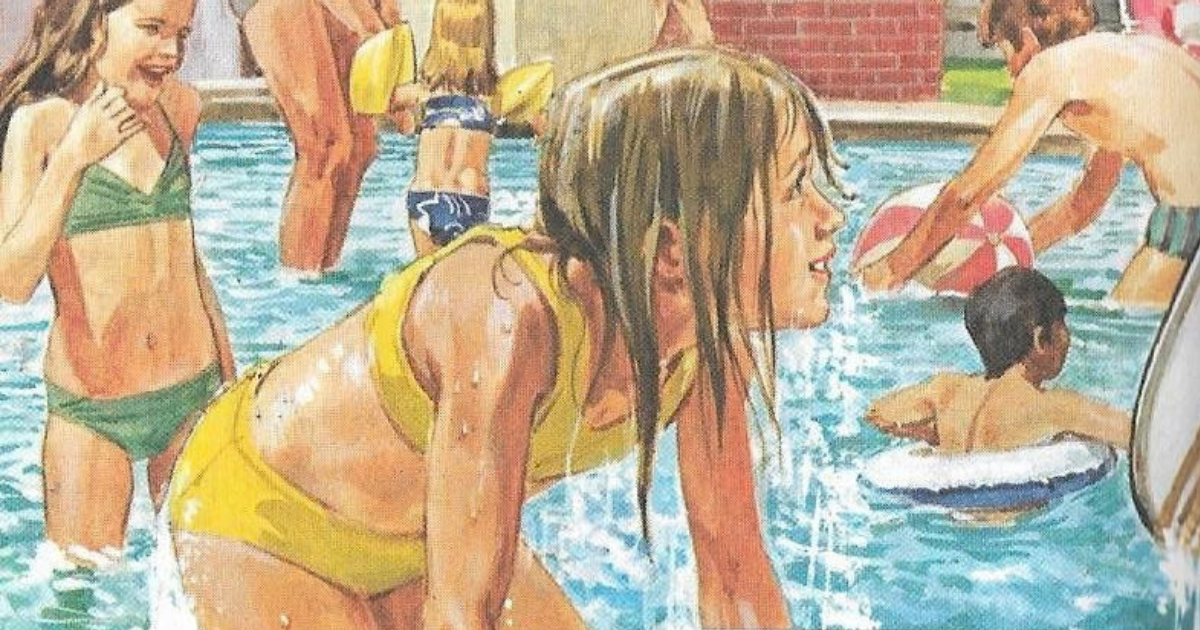
By the 1970s, girls are getting wet.
If you’re looking to deepen your understanding, the Children’s Literature Exploration course invites you to journey into the fascinating world of books written for children.

Online Training Academy
The 1960s: Boys Play, Girls Sunbathe
The traditional British seaside holiday provides the setting for the 1960s Ladybird book Happy Holidays.
The illustrations capture familiar rituals of a British holiday: the seaside, ice creams, games and the almost obligatory pot of tea. Yet beneath this nostalgic picture lies a striking division between the activities of boys and girls.
The body language tells much of the story.
Boys are generally portrayed as confident and active. They run, explore, lean out, take risks and occupy the foreground. When there is an opportunity for energetic play — particularly anything involving water — boys are usually the ones getting involved.
Girls, meanwhile, are more cautious.
They sit and sunbathe, carefully maintaining their appearance and keeping their dresses in place. Rather than charging ahead, they are more likely to remain safely positioned behind the boys.
Even the composition of the illustrations can reinforce this difference. Boys frequently occupy the frontward position while girls appear to lag behind.
It is a visual language of childhood in which adventure is masculine and caution is feminine.

Ladybird
What Were Girls Expected to Do?
The distinction goes beyond physical activity.
The girls depicted in these books are often associated with traditionally feminine interests. In one scene, a girl identifies wildflowers — an activity that is quiet, observational and considerably less physical than the activities being undertaken by the boys.
There is an interesting contradiction, however.
Although girls may be presented as physically cautious, they can appear surprisingly capable when it comes to academic activities. Reading and writing are sometimes depicted as areas where girls are ahead of the boys.
So the message isn’t necessarily that girls are less capable.
Rather, it suggests that different kinds of capability are being assigned to boys and girls.
Boys are physically adventurous.
Girls are observant, careful and academically capable.

Clothing as a Symbol of Gender
Clothing is another revealing feature of these illustrations.
Boys are typically dressed for activity, wearing practical T-shirts and shorts. Girls, on the other hand, are frequently shown in delicate sun dresses.
That difference might appear superficial today, but clothing can tell us a great deal about how childhood was imagined.
The boy’s clothes allow him to run, climb, swim and get dirty.
The girl’s clothing suggests that she should remain neat.
The implication is subtle but powerful: boys’ bodies are prepared for action, while girls’ bodies are expected to remain presentable.
A Very White Childhood
There is also a striking lack of racial diversity in many of these mid-century children’s books.
The children represented are predominantly white and often conform to a very narrow visual ideal of British childhood. Traditional clothing and settings reinforce the impression of an overwhelmingly white, conventional Britain.
This matters because children’s books don’t simply reflect society — they can also help define who is imagined as belonging within it.
The world presented to young readers in the 1960s was therefore not simply divided by gender. It was also relatively homogeneous in its representation of race and identity.

1970s Ladybird Book
The 1970s: Something Is Changing
Then comes the 1970s.
The social landscape is changing. Second-wave feminism is challenging traditional assumptions about women’s lives, domestic roles and expectations, and those wider cultural changes begin to filter into children’s literature.
One fascinating example is the Ladybird classic Out of the Sun.
At first glance, some of the old conventions remain.
On the cover, the boy is positioned ahead, apparently helping the girl — continuing the familiar visual idea of the boy as stronger, more adventurous or protective.
Inside, boys are still drawn towards activities resembling traditional hunter-gatherer roles. They use tools and explore their surroundings, while girls can still be found engaged in activities such as flower picking.
So this isn’t a complete revolution.
But the boundaries are beginning to loosen.

Ladybird
Girls Get Practical
One of the most noticeable changes is clothing.
Girls are now much more likely to be wearing T-shirts and jeans rather than delicate dresses.
That might sound like a small change, but it has a significant effect on how girls can be represented.
A girl in jeans can run.
She can climb.
She can tackle.
She can get dirty.
And, crucially, she can get wet.
The practical clothing reflects a broader change in expectations: girls are increasingly being presented as physically active participants rather than passive observers.

Girls Get Wet!
This is where the difference between the decades becomes particularly striking.
In the 1960s, the girl at the seaside is likely to be sitting safely on the beach, sunbathing while the boys play in the water.
In Out of the Sun, we see something very different.
Girls participate in rough-and-tumble activities. One girl is even shown tackling a dog with a walking stick.
But perhaps the most revealing image is the girl emerging from the swimming pool.
She is wet.
Not delicately paddling at the edge.
Not sitting beside the pool.
Not watching the boys.
She has been fully immersed in the water and is actively participating in swimming and water games.
It is a wonderfully simple visual representation of changing expectations.
The girl isn’t simply allowed to get wet. She is allowed to enjoy herself while doing it.
Race and Representation Begin to Change
There are other signs of social change within these 1970s books.
Although white children still dominate the illustrations, children with different hair colours and physical features are increasingly visible.
More significantly, children from ethnic minority backgrounds begin to appear as active members of groups of friends, rather than being entirely absent from the imagined world of childhood.
It would be wrong to suggest that children’s literature had suddenly become fully representative. It hadn’t.
But compared with the narrow visual world of earlier decades, the change is significant.
The children’s world is beginning to look slightly more like the society outside the pages.

Race and Representation
From Tea and Ice Cream to Healthy Eating
Even attitudes towards everyday life appear to be shifting.
The traditional seaside rituals of the 1960s — ice cream, tea and holiday treats — sit alongside newer ideas in the 1970s about healthy eating and active lifestyles.
Children are encouraged to be active, play outdoors and participate in physical activities.
The books therefore provide a fascinating record of changing ideas about what constitutes a healthy and desirable childhood.
Even the domestic interiors can reveal the culture of the period. A Union Jack duvet cover, for example, introduces an element of British patriotism into the child’s environment.
What Ladybird Books Tell Us About Gender
Perhaps the most interesting aspect of comparing these two decades is that the transformation isn’t absolute.
Traditional gender roles remain visible throughout the 1970s.
Boys still tend to be adventurous.
Girls still participate in traditionally feminine activities.
Boys still use tools.
Girls still pick flowers.
The difference is that the boundaries are becoming less rigid.
Girls can now cross into the traditionally masculine territory of physical adventure.
They can wear practical clothes.
They can participate in rough-and-tumble play.
They can swim.
And they can emerge from the pool absolutely drenched.

Girls wear Practical Clothing
A Decade of Change
In the space of just ten years, the visual language of childhood has changed considerably.
The 1960s girl sits on the beach while the boys play in the water.
The 1970s girl gets into the water herself.
That seemingly insignificant image tells us something much bigger about changing attitudes towards girls and women’s place in society.
The shift towards practical clothing, greater physical activity and more diverse representations of children reflects a decade in which traditional assumptions were increasingly being questioned.
Ladybird books weren’t necessarily feminist manifestos. They continued to reproduce many conventional ideas about gender, race and family life.
But they also reveal the gradual loosening of those conventions.
And perhaps that’s why these books remain so fascinating today.
They are not just childhood reading books.
They are cultural time capsules.
Open a 1960s Ladybird book and you can see one version of British childhood.
Open a 1970s edition and you can see another beginning to emerge.
And sometimes, the difference between the two can be summed up remarkably simply:
In the 1960s, girls stayed dry.
In the 1970s, girls got wet.
Books to Explore Further
If this article has made you curious about how children’s books reflect changing attitudes towards gender, society and technology, these titles offer some interesting ways to explore the subject further.
Ladybird Tales of Adventurous Girls
Today’s Ladybird books place girls firmly at the centre of the action. From taking on key roles to embarking on adventures, these stories offer a very different picture of what girls can do compared with the more traditional representations found in earlier Ladybird books.

The Ladybird Book of Red Tape
A satirical look at modern life using the distinctive illustrations of the original 1960s and 1970s Ladybird books. One story follows someone making endless phone calls in an increasingly frustrating attempt to reset her email password — demonstrating how these familiar images can be repurposed to poke fun at contemporary life.

Furious
How will we navigate children’s books beyond the printed page? Furious explores technological feminism and digital futures, asking how feminism, technology and storytelling might intersect as children’s experiences increasingly move beyond traditional books.

Technological Feminism and Digital Futures
Feminism and Women’s Writing
This book offers a clear and accessible introduction to the ways feminist ideas have transformed both the form and content of British women’s fiction and non-fiction writing. It provides useful context for understanding the wider feminist changes that were taking place alongside the evolving representations of girls and women in children’s literature.

An Introduction
Catherine Riley, Lynne Pearce
This article contains affiliate links, which means I may earn a small commission if you click through and make a purchase — at no extra cost to you.


Leave a Reply