
https://pagead2.googlesyndication.com/pagead/js/adsbygoogle.js?client=ca-pub-4000887400212447
What does friendship look like 25 years after the world changed? Once, We Were Friends is a work of flash fiction about 9/11, memory, friendship, betrayal and the changing relationship between Britain and America.
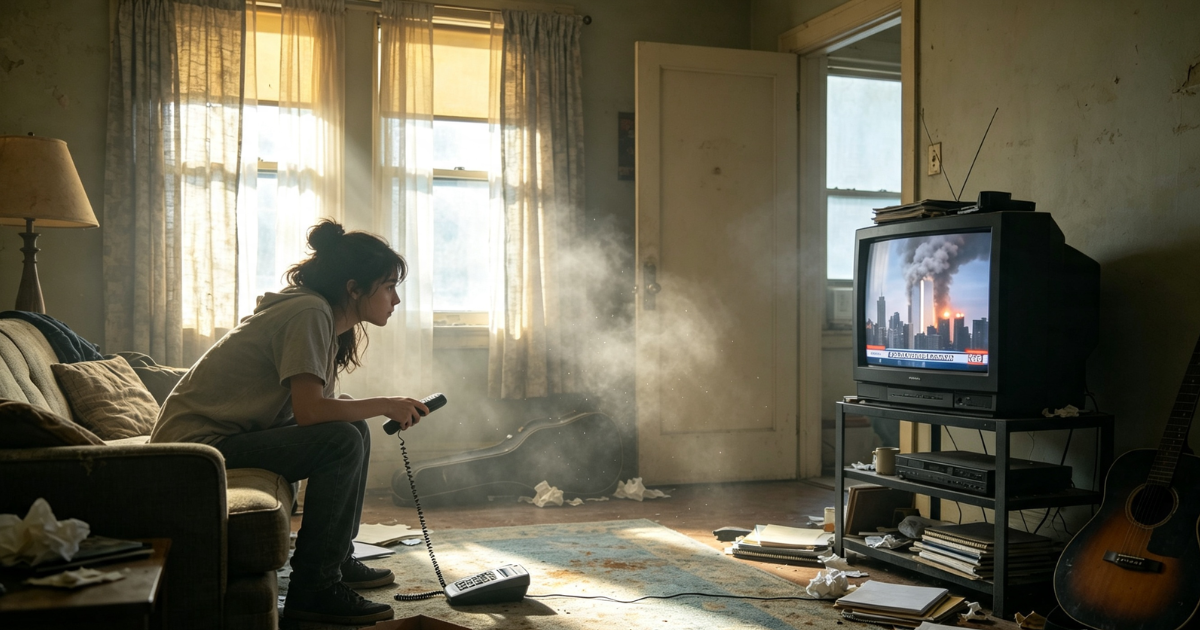
Set on a warm September morning in a shabby student house, the story begins with a knock at the door and a television being switched on. What follows is the shock of watching the Twin Towers fall on September 11, 2001, and the desperate search for friends in New York as the world tries to understand what has happened.
But this is also a story about what happens afterwards. Friendships change. People disappear from our lives. Trust can fracture. And relationships that once seemed permanent can become almost unrecognisable.
Against the backdrop of the UK-US “special relationship”, Once, We Were Friends explores whether countries, like people, can lose their way—and whether, after years of distance, conflict and betrayal, friendship can ever be rebuilt.
Alison Little, the author behind Once, We Were Friends, has completed the Fictionalising Your Life: A Creative Writing Approach course, which explores how writers can transform personal experiences into compelling fiction. The course also covers handling darker themes and challenging narratives, helping writers approach complex and difficult subject matter within their creative work.

A Creative Writing Approach
Once, We Were Friends
The knocking came through the sleep.
Three times.
Or four.
I don’t remember.
The room was hot, the curtains half-drawn, September pressing its face against the glass. My friend was beside me, though beside is the wrong word. We occupied the same bed in the way two people can occupy a lifeboat: separately, temporarily, without touching.
He was gay.
This mattered then.
Or perhaps I only thought it mattered.
The house was a Victorian terrace pretending not to be a student house. Cheap paint. Damp corners. A landlord’s idea of maintenance applied with the minimum possible enthusiasm. Everything cost too much and looked as though it had cost nothing.
I had come back from America early.
New York was behind me.
I had spent the summer there trying to become someone else and had failed spectacularly.
My dreams were dead.
My life was elsewhere.
The world, though I didn’t know it yet, was waiting for another death.
The knocking again.
Our friend.
He came in.
He didn’t say much.
He turned on the television.
And there they were.
Two buildings I had looked up at just weeks before.
Two buildings I suddenly felt I knew.
Smoke.
Glass.
People running.
A plane becoming a weapon.
A building becoming a grave.
Then the first tower folded.
We watched.
Then we watched it again.
And again.
Television had discovered repetition.
The dead were made to die continuously.
Nobody spoke.
Outside, the sun continued.
Somewhere, a kettle clicked off.
A car went past.
The ordinary world, insultingly, refused to stop.

The News
By afternoon I began thinking of the people I had known in America.
Names surfaced.
Faces.
Voices.
People I had spent the summer trying not to like.
People I suddenly needed desperately to be alive.
I needed the internet.
This was strange.
Before America, the internet had been an unnecessary room in the house of technology. I had email. A phone. Snake.
Snake.
That was enough.
Information came from newspapers, notices, telephone calls, little strips of paper torn from advertisements.
Now I needed a machine to tell me whether my friends were alive.
The lines to America were dead.
The internet was mostly silence.
Eventually, one message arrived.
Safe.
Another.
Safe.
Another.
Safe.
The word became enormous.
Safe.
For a while, that was enough.
For a while, the world divided itself into two categories:
alive
and
not alive.
And we belonged to the first.
We were young.
We were students.
We were broke.
We were high.
We were frightened.
We were together.
For one strange day, everybody was somebody’s friend.
Twenty-five years is a long time to lose people.
Some disappear suddenly.
Some slowly.
Some remain close enough to touch and turn out to be strangers.
The American friend I had searched for became, eventually, someone I wished I had never known.
The friend beside me became another kind of mistake.
There were intentions beneath friendships.
Hands beneath words.
Control beneath affection.
And then there were the ordinary disappearances.
The friend who knocked.
The friends we promised to see.
The friends who moved.
The friends who married, divorced, changed jobs, changed cities, changed themselves.
Nobody slammed the door.
Nobody announced the ending.
The doors simply became further away.
Perhaps countries are like that.
Once, America and Britain stood shoulder to shoulder.
After the towers fell, the distance between us seemed to disappear.
Now there are tariffs.
Threats.
Maps being renamed.
Old alliances handled like furniture somebody wants to throw away.
The special relationship sits somewhere between the two countries like an old photograph neither quite knows whether to keep.
Perhaps this is how things end.
Not with an explosion.
Not even with a collapse.
But with a gradual failure to recognise the person standing opposite you.
I think of the terrace.
The cheap paint.
The heat.
The television.
The knocking.
The two towers standing impossibly tall against a blue September sky.
And the strange intimacy of watching them fall with people you barely knew.
For one morning, we were all frightened together.
For one morning, nobody was trying to control anybody.
Nobody wanted anything.
Nobody had a political position.
Nobody had a new map.
There was only the television.
The smoke.
The silence.
And the word:
safe.
I wonder if that word is still possible.
Not between countries.
Not between friends.
Not between people who have learned how easily everything can fall.
But perhaps, somewhere, behind all the noise, there is still a door.
And someone is still knocking.
Three times.
Or four.

The News
Author’s Note
Once, We Were Friends is a work of fiction. All characters, relationships and locations depicted in the story are fictional and are not intended to represent real people or places. Any similarities to actual individuals, locations or events are coincidental, although the story is set against the backdrop of real historical events, including the attacks of September 11, 2001.
The story uses these events as a starting point to explore memory, friendship, betrayal, loss and the way relationships—both personal and political—can change over time.
Books Behind the Themes
If Once, We Were Friends has made you think about friendship, memory, betrayal and the events that shaped the early 21st century, you might also enjoy these books.
Season of Wolves A History of the Post-9/11 World
In Season of Wolves, Mohammad-Mahmoud Ould Mohamedou challenges the way the post-9/11 world has largely been understood through the lens of terrorism, security and the “War on Terror.” Instead, he offers a broader history of the first quarter of the twenty-first century, examining the political forces and global changes that have shaped the world since September 11, 2001.

A History of the Post-9/11 World
Mohammad-Mahmoud Ould Mohamedou
The Things We Never Say Elizabeth Strout
A moving new novel about love, loneliness, grief and new beginnings from Pulitzer Prize-winning author Elizabeth Strout, best known for My Name Is Lucy Barton. Strout beautifully explores how grief can echo through decades, while showing the enduring comfort, complexity and importance of deep friendship.

Elizabeth Strout
Write Now 100 Writing Prompts to Kick-Start Your Creativity
Writing for yourself is a great way to unlock your creativity and develop your voice. With 100 inspiring writing prompts, this book will help you build confidence, strengthen your writing skills and take another step towards becoming the writer you want to be.

100 Writing Prompts to Kick-Start Your Creativity
There’s nothing quite like getting your ideas down on paper in a Moleskine notebook. Order one online, have it delivered to your door, then settle down with a pen and start scribbling.

Myrtle Green
This article contains affiliate links, which means I may earn a small commission if you click through and make a purchase — at no extra cost to you.

Leave a Reply