
https://pagead2.googlesyndication.com/pagead/js/adsbygoogle.js?client=ca-pub-4000887400212447
When we think of comics, we often imagine superheroes, exaggerated characters and adolescent power fantasies. For much of the twentieth century, comic books were regarded as popular entertainment rather than serious literature. Art Spiegelman’s Maus challenged that assumption, demonstrating that the graphic novel could explore history, trauma, identity and the darkest aspects of human behaviour with extraordinary depth.
First serialised in the alternative comics magazine Raw and later published as two books, Maus tells the story of Spiegelman’s father, Vladek, a Polish Jewish survivor of the Holocaust. Through interviews with his father, Spiegelman reconstructs the persecution of European Jews, from the growing threat of Nazi Germany to Auschwitz and the struggle to survive after liberation.
Yet Maus is more than a historical account. It is also a story about a difficult father-son relationship, the transmission of trauma between generations and the challenges of representing an experience that resists conventional storytelling. Its distinctive visual language demonstrates how the graphic novel can become a sophisticated literary form.

Vladek Spiegelman
Auschwitz

Cats, mice and the language of prejudice
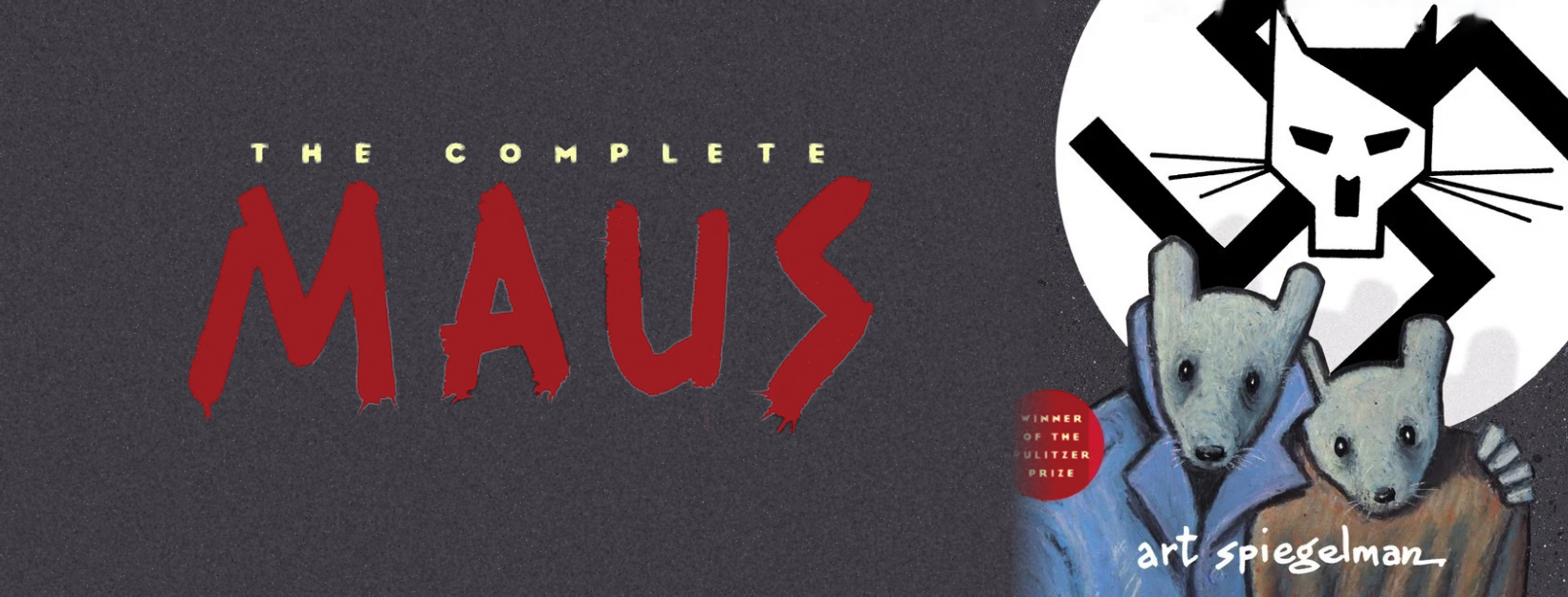
One of the most striking features of Maus is Spiegelman’s use of animals to represent different nationalities and ethnic groups. Jewish people are mice, Germans are cats, ethnic Poles are pigs, and Americans are dogs.
The central metaphor is immediately recognisable. Cats hunt mice, establishing a visual relationship between persecutors and victims. It also reflects Nazi ideology, which portrayed Jewish people as vermin. Spiegelman transforms this dehumanising imagery into a means of exposing its consequences.
The German cats are often physically imposing, armed and confident, while Jewish mice appear vulnerable and constantly threatened. As the story progresses, the first appearances of Nazi uniforms, military vehicles and swastika flags give way to increasingly dark and oppressive imagery. The black backgrounds surrounding the flags establish a visual atmosphere of menace.
However, the animal metaphor is not a simple division between good and evil. The behaviour of individual characters complicates their assigned identities, revealing prejudice, collaboration, resistance and kindness across national boundaries.
The decision to depict Poles as pigs has proved controversial, with some Polish readers and officials objecting to what they regard as an unfair generalisation. This raises an important question: can a visual metaphor expose racism while also risking the reinforcement of stereotypes?
That tension is part of what makes Maus so compelling. Its imagery invites readers to examine both the history being represented and the ethical difficulties of representing it.

The first Appearance
A visual language of confinement
Spiegelman’s illustration is economical but remarkably expressive. His use of black-and-white imagery, strong outlines, contrasting layouts and simplified backgrounds creates a visual language that changes with the circumstances of the story.
The cramped spaces of the ghettos and concentration camps are particularly effective. Simple lines suggest corrugated metal huts, narrow passages and makeshift accommodation. The lack of elaborate detail makes the deprivation feel stark and immediate.
In some sequences, the pathways through a ghetto form a pattern resembling a swastika. The symbol becomes part of the architecture of persecution, suggesting that danger surrounds the characters in every direction. Escape is not simply a matter of finding an unlocked door; the entire environment restricts their freedom.
Clothing is equally significant. Striped prisoner uniforms, poorly stitched Jewish stars and barbed wire become recurring reminders of captivity. Heavy black panel borders reinforce the impression of lives enclosed within an oppressive system.
Spiegelman contrasts the smart, well-maintained uniforms of the Nazis with the deteriorating appearance of the prisoners. This difference exposes the enormous imbalance of power between those controlling the camps and those whose lives depend on their decisions.
The illustrations also communicate the normalisation of death. Prisoners starve and collapse while surrounded by others in similar conditions. One observation captures the cruelty of the rations: the food provided was just enough to make a person die more slowly.
At other moments, the horror lies in the loss of dignity. Prisoners are forced to stand naked for inspection. When they enter the showers, they are relieved to discover that water comes from the taps rather than gas. That brief relief is devastating because it shows how completely the threat of immediate death has entered everyday life.
Spiegelman rarely needs to illustrate every atrocity explicitly. A single image or carefully chosen line of dialogue can convey the horror more effectively than a graphic depiction.

Animal masks and the performance of identity
One of the most revealing devices in Maus is the use of animal masks.
When Vladek and his wife, Anja, attempt to escape capture by passing themselves off as ethnic Poles, they wear pig masks. The disguise offers temporary protection, allowing them to move through a society where being identified as Jewish could mean death.
The mask represents more than a practical trick. Identity becomes something that must be concealed or performed according to circumstances. Survival depends on convincing others that you belong to a group that is not being hunted.
Yet the couple also encounters prejudice among ordinary people. One neighbour helps them, while another expresses hostility towards Jews. The casual remark about a Jew being in the courtyard reveals the willingness of some people to cooperate with persecution.
Spiegelman returns to the mask motif in contemporary America, where Art discusses publishing Maus. Publishers and interviewers also appear in animal masks, suggesting that identity remains complicated long after the Holocaust.
In one revealing exchange, Art is asked which animal he would choose to represent an Israeli Jew. His answer is a porcupine, an animal capable of defending itself without necessarily initiating a fight.
The porcupine suggests a community seeking protection against future threats. It also opens up questions about Israel’s relationship with the United States. Some critics have characterised Israel as a strategic satellite of American power, dependent on US military, financial and diplomatic support. This is a political interpretation raised by the wider context rather than a conclusion established by the animal image itself.
The scene demonstrates how a deceptively simple question about animals can introduce complicated debates about national security, Jewish identity and American influence.
As the interview continues, Art visibly shrinks in his chair until he appears childlike. His final plea for his mother reveals the emotional vulnerability beneath his intellectual arguments. Even as an adult trying to explain his work, he remains a son shaped by his family’s history.

Modern America
Interviewers wear Animal Masks
Two timelines: wartime Europe and contemporary America
Maus moves between wartime Europe and contemporary America, where Art interviews his father about the past. The two timelines are distinguished through carefully controlled graphic techniques.
The wartime story is frequently presented within firm, enclosed panels. Dark backgrounds and tightly organised compositions reflect the characters’ lack of freedom. The contemporary scenes, by contrast, are often more open.
Vladek is repeatedly shown exercising on an exercise bike while talking to his son. The bike establishes that we are in the present, while also reminding us of his ageing body and attempts to maintain control over his life. He often appears larger in these scenes, wearing modern Western clothing such as a checked jacket.
Art is shown listening, taking notes and asking questions. Their conversations sometimes extend beyond the panel boundaries, disrupting the separation between past and present. The page cannot entirely contain the consequences of what is being remembered.
Their relationship is not sentimentalised. Vladek can be controlling, difficult and preoccupied with money and possessions, while Art sometimes becomes impatient with him. Their exchanges can be funny, uncomfortable and frustrating.
Yet Vladek’s habits and anxieties become more understandable when we recognise the experiences that shaped him. What might appear to be ordinary domestic arguments acquire another dimension when considered against his history of persecution and deprivation.
The contrast between the two timelines makes memory itself a subject. Art is not a detached historian reconstructing events from a distance; he is a son trying to understand his parents while turning their experiences into a form other people can comprehend.

Vladek Spiegelman and Art in conversation
Illustration for rear cover
Art Spiegelman, mental health and his mother’s suicide
The relationship between Art Spiegelman and his parents is central to understanding Maus. His mother, Anja, survived the Holocaust but struggled with her mental health. She died by suicide in 1968, when Art was 20 years old.
Art himself had experienced a mental health breakdown shortly before his mother’s death and spent time in a state mental hospital. These events profoundly affected his relationship with his family and his understanding of his own emotional life.
Spiegelman explores this period in Prisoner on the Hell Planet: A Case History, an expressionistic comic strip incorporated into Maus. Unlike the main narrative’s animal characters, this sequence depicts Art and his family as human figures. Heavy black backgrounds, distorted forms and prison-like compositions create a visual language of grief, guilt and psychological confinement.
Art depicts himself wearing the striped uniform different to one worn by a concentration camp prisoner. The disturbing image connects his emotional suffering with the experiences of his parents, although the two forms of suffering are not equivalent.
Anja left no suicide note, leaving her son without an explanation for her death. His feelings of anger, confusion and guilt become intertwined with his attempts to understand her life.
This is one of the most important aspects of Maus: its exploration of transgenerational trauma, the ways traumatic experiences can influence subsequent generations. Art was born after the war, but the Holocaust shaped his childhood, his relationship with his father and his understanding of himself.
The inclusion of Prisoner on the Hell Planet also demonstrates Spiegelman’s willingness to change his artistic style when the subject demands it. The radically different imagery exposes the emotional reality beneath the main narrative and challenges the assumption that comics are inherently light-hearted or simplistic.

Prisoner on the Hell Planet
Auschwitz: survival measured in the smallest things
As the narrative moves into Auschwitz, the visual world becomes increasingly oppressive. Striped uniforms, barbed wire and the threat of the gas chambers dominate the pages.
Yet Spiegelman also shows how survival depends on small opportunities and exchanges.
Vladek secures work as a shoemaker. When a Gestapo officer demands that he repair a pair of boots by the following day, failure could mean death. Vladek arranges the repair through another workshop, sacrificing his bread ration, and receives a sausage as a reward.
The illustration of Vladek holding the sausage, with a small star-like highlight drawing attention to it, is particularly effective. In another context, a sausage would be an ordinary item of food. Here it becomes an object of extraordinary value, representing a moment of relief from hunger.
Food, cigarettes, clothing and work assignments become instruments of survival. Prisoners with useful skills sometimes receive privileges, but these advantages remain precarious, dependent on the needs and whims of those in power.
Vladek’s attempts to help Anja make this danger particularly clear. When he risks punishment by taking her food, he is caught and beaten. The German guard’s posture and expression suggest not merely the exercise of authority but the enjoyment of cruelty.
Other prisoners help carry Vladek away after the beating. Their solidarity offers a brief contrast to the brutality of the camp, while his relief that Anja has not been caught reveals how central his concern for her remains.
Spiegelman also depicts prisoners being inspected naked and divided according to their fitness for work. Those considered unfit face death, while the smoking chimney becomes a recurring symbol of the fate awaiting many inmates.
The narrative does not portray the camps as places where every prisoner shares the same interests or experiences. Internal hierarchies, political disagreements and competition for scarce resources continue to shape relationships.
Yidl, a Russian Jewish prisoner placed in a position of authority at Auschwitz, illustrates these divisions. He criticises Vladek for his former business interests, accusing him of exploiting workers and condemning him as a capitalist. Vladek recognises Yidl’s communist outlook.
The episode reveals how class and political ideology persist even in an environment dominated by starvation, forced labour and death. The Nazi system exploited prisoner hierarchies to administer the camps, creating inequalities among people who were themselves victims of persecution.
Spiegelman does not suggest that these conflicts were equivalent to Nazi violence. Instead, they show how the camp system distorted relationships and made access to food, work and relative security sources of power.

Auschwitz – Survival
Heinrich Himmler, the Red Cross and the final months of the war
As Soviet forces advanced, prisoners were transported away from Auschwitz towards camps further inside Germany. The journeys brought new dangers: overcrowded trains, extreme cold, inadequate food and the collapse of already fragile bodies.
Vladek survives partly by eating snow for water. When another prisoner asks for some, he is reluctant to share what he needs himself. He eventually trades snow for sugar, illustrating how even basic necessities become commodities.
A Red Cross visit during this period introduces another uncomfortable aspect of the Holocaust: the use of humanitarian gestures for political purposes.
During the final months of the war, senior Nazi officials explored ways to use surviving prisoners as bargaining assets in negotiations with the Western Allies. Heinrich Himmler, head of the SS and one of the principal architects of the Holocaust, became involved in attempts to negotiate with the Allies as Germany faced defeat.
The release or exchange of prisoners could be used to seek political concessions or improve Germany’s negotiating position. Humanitarian access therefore existed alongside the continuing persecution, forced labour and mass murder of prisoners.
Red Cross visits and food distributions could provide temporary relief, but they did not signify a fundamental change in Nazi policy. The political context makes these scenes particularly disturbing: a piece of bread or a cup of coffee offers immediate relief within a system that has systematically deprived people of food, dignity and freedom.
Disease added to the suffering. Typhus, transmitted by body lice in its epidemic form, spread rapidly in overcrowded camps with inadequate sanitation. Starvation and exhaustion made it harder for prisoners to survive infection.
Anne Frank and her sister, Margot, died of typhus at Bergen-Belsen in February or March 1945, shortly before British forces liberated the camp on 15 April. They had been deported to Auschwitz in 1944 before being transferred to Bergen-Belsen.
Anne Frank’s death illustrates how liberation could come too late for prisoners already weakened by disease and deprivation. The Holocaust cannot be understood solely through the machinery of mass murder; starvation, forced labour, illness and the systematic destruction of the conditions necessary for human life also killed enormous numbers of people.
By depicting prisoners struggling with illness as the war approaches its end, Spiegelman challenges the comforting idea that survival was assured once the Nazis began to lose. The final months remained deadly, and survival could depend on a few days or the body’s ability to withstand another infection.

Red Cross
Liberation does not mean the end of persecution
When American soldiers finally encounter the survivors, their appearance and behaviour contrast sharply with those of the German guards. Represented as dogs, the Americans are generally depicted as kind and reassuring.
Vladek’s earlier relationship with a German officer who employs him as a shoemaker provides a more complicated contrast. The officer can be threatening and brutal, yet later rewards Vladek for his work. Spiegelman shows how survival sometimes depends on navigating unpredictable individuals within a fundamentally violent system.
Liberation does not produce an uncomplicated happy ending. Prejudice persists, and Jewish survivors returning to their former homes in Poland may encounter hostility and violence. Some discover that their property has been occupied or taken over, while others face threats when attempting to reclaim it.
The Kielce pogrom of July 1946, in which 42 Jews were killed, became one of the most notorious examples of postwar antisemitic violence in Poland. Such events demonstrate that the defeat of Nazi Germany did not automatically end antisemitism or guarantee safety for Jewish survivors.
Vladek eventually rebuilds his life, returns to business and later emigrates to the United States. His ability to recover material security is striking, but it does not erase the experiences that shaped him. The story’s movement towards liberation is accompanied by an awareness that the psychological consequences of the Holocaust continue long after the fighting ends.

Discrimination aftermath of returning from the camps.
From underground comics to the Pulitzer Prize
Spiegelman’s achievement becomes even more significant when considered against the history of American comics.
Born in Sweden in 1948, he grew up in New York and began drawing comics as a child. By the 1970s, he was part of the underground comics movement, which challenged the conventions of mainstream comic books and explored subjects traditional publishers often avoided.
Mainstream American comics had largely been associated with superhero adventures and mass-market entertainment. Although underground artists expanded the medium’s possibilities, comics were still frequently dismissed as incapable of serious literary expression.
Spiegelman initially conceived the cat-and-mouse idea for a story about racism, imagining the Ku Klux Klan as cats pursuing African American mice. He later developed the concept into Maus, applying the visual metaphor to the history of Nazi persecution.
The project required extensive research. Spiegelman interviewed his father, read survivors’ accounts and consulted other historical material. He also visited Auschwitz in 1979. The finished work is rooted in testimony and historical investigation, even as it employs the imaginative techniques of comics.
His visual approach contributes to the book’s documentary quality. Spiegelman wanted the pages to retain a diary-like immediacy, reproducing the drawings at their original size and using a fountain pen. The hand-drawn lines preserve the sense of a person struggling to record events that are difficult to comprehend.
The book’s publication challenged the expectations of the publishing industry, reaching readers through conventional bookshops rather than being confined to specialist comic shops. In 1992, Spiegelman received the Pulitzer Prize Special Award for Maus, a landmark in the recognition of comics as serious literary work.
The book has since been translated into numerous languages and studied in schools and universities. However, its reception has not been without controversy. Some Holocaust survivors have objected to the use of comic-book imagery to represent their suffering, arguing that animal metaphors risk trivialising or dehumanising victims. Others have questioned the depiction of particular nationalities.
These criticisms deserve consideration. The accessibility of the medium does not remove the ethical responsibilities involved in representing historical suffering. Yet Maus encourages precisely the kind of debate that serious art should sustain.

Typhus
All Nationalities
Why Maus is one of the most important graphic novels ever written
Maus is a graphic novel like no other because it combines historical testimony, family memoir, political argument and formal experimentation without allowing any one element to dominate.
Its animal characters are immediately recognisable, but their significance becomes increasingly complex. Its illustrations are often simple, yet their composition, framing and use of contrast communicate ideas that would be difficult to convey through words alone.
The movement between wartime Europe and contemporary America shows that history is not safely confined to the past. It continues through memory, behaviour, grief and relationships between generations.
The book also demonstrates that visual storytelling need not simplify difficult subjects. The masks, shifting panel boundaries and contrasting timelines allow Spiegelman to explore contradictions, silences and uncomfortable questions. The narrative is as much about the act of remembering as it is about the events being remembered.
There is a further irony in the fact that a book using animal characters reveals so much about dehumanisation. The Nazis reduced people to categories, stripping them of individuality and dignity. Spiegelman uses simplified animal forms to expose the violence of that thinking, while leaving readers to consider the limitations and dangers of the metaphor itself.
Maus helped establish the graphic novel as a form capable of serious historical and literary expression. Its importance lies not simply in the recognition it received, but in the possibilities it opened up for other artists and writers.
The medium can entertain, make us laugh and transport us to imaginary worlds. It can also confront us with genocide, prejudice, starvation and the lasting consequences of trauma.
In Spiegelman’s hands, the drawn line becomes a means of recording history, questioning identity and exploring the emotional legacy of survival. Maus reminds us that the form in which a story is told does not determine the seriousness of its subject. Sometimes, a few stark images and carefully chosen words can make history feel more immediate, more personal and more difficult to forget.
Further Reading
Read: The Complete MAUS

Art Spiegelman
Explore: Maus Now

Selected Writing
Edited by Hillary Chute
Discover his later work: In the Shadow of No Towers

Art Spiegelman
Collect: Maus I & II Paperback Box Set

Paperback Box Set
Art Spiegelman
You may also be interested in The Pianist, which makes its world stage premiere at London’s Park Theatre for a strictly limited run. Based on Władysław Szpilman’s internationally acclaimed memoir and featuring his own music, this moving new production brings to life one of the most extraordinary true stories of the 20th century.

Park Theatre
London
This article contains affiliate links, which means I may earn a small commission if you click through and make a purchase — at no extra cost to you.
Leave a Reply