
https://pagead2.googlesyndication.com/pagead/js/adsbygoogle.js?client=ca-pub-4000887400212447
Invasion is an unsettling, confrontational sculpture that forms the first instalment in SV: Sex by Violence, a series of four animated works exploring the physical and psychological realities of sexual violence. Rejecting passive viewing, the piece demands a direct and uneasy engagement, tracing the moment of violation through a visceral sculptural language that foregrounds the body as a site of conflict rather than representation.

The work, comprising four animated sculptures, resists passive viewing. Instead, it demands a reckoning with the physical and psychological realities of sexual violence, tracing a trajectory from assault through to the fragile notion of recovery.
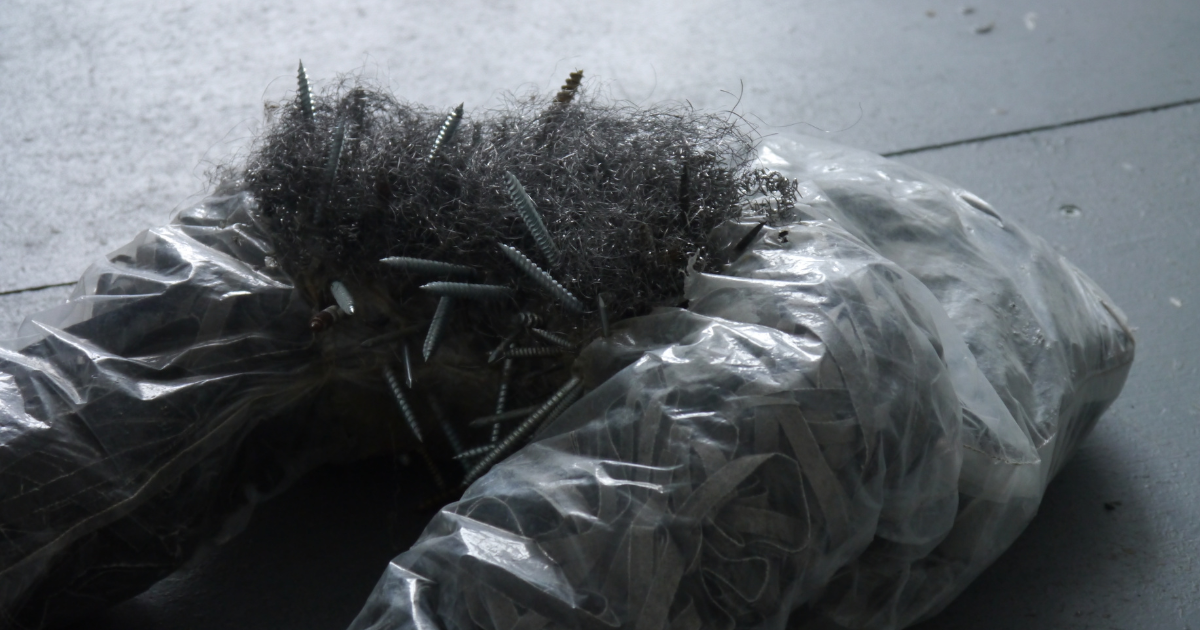
Invasion, the first piece in the series, centres on the female body—not as an object of aesthetic admiration, but as a site of conflict. The sculpture, constructed from polythene, shredded paper and found materials, replicates the lower torso and legs of a woman. Its form is at once recognisable and alien: limbs lie flattened and inert, while the groin area thrusts upward, creating a disquieting tension between vulnerability and resistance.
The most striking—and jarring—feature is the cluster of nails protruding from the groin. These are not merely symbolic; they evoke the body’s involuntary muscular resistance to violation. Rather than depicting passivity, the work insists on the body’s instinctive fight against intrusion. The rusted surfaces of the metal intensify this reading, suggesting both the brutality of the act and the corrosive, lingering aftermath of trauma.
Material choice is central to the work’s impact. Wire wool and domestic scourers stand in for pubic hair, their degraded, oxidised textures conveying abrasion and rejection. These everyday objects, typically associated with cleaning, are recontextualised into instruments of discomfort—harsh, resistant surfaces that appear to push back against penetration. The result is a visceral contradiction: the suggestion of both assault and defiance embedded within the same textures.
The body itself is bulked out with darkened, compacted paper, forming a rough, almost granite-like mass. This is not flesh as we know it, but something hardened, obstructed, and altered. The interior life of the body—its circulation, its vitality—is implied to be disrupted, even arrested. What should be organic becomes inert, signalling the profound internal impact of violence.

At the extremities, the feet are encased in stone. This detail anchors the figure physically and metaphorically: the body is immobilised, unable to flee. The use of beach detritus—sand, slate, and other natural debris—introduces an ambiguous setting, somewhere between shoreline and quarry. These elements weigh the sculpture down, embedding it in a landscape that feels both exposed and isolating. The coarse sand appears to infiltrate the body itself, staining it, suggesting how trauma permeates beyond the immediate moment.
Around the groin, slabs of slate compress the form further. As they grind against one another, they produce a dark residue that seems to spread across the sculpture, reinforcing a sense of suffocation and entrapment. The body is not only violated but burdened, pressed into stillness.
What makes Invasion particularly difficult—and necessary—is its refusal to aestheticise or distance its subject. There is no metaphorical veil thick enough to soften the reality it confronts. Instead, the work occupies an uneasy space between representation and embodiment, forcing the viewer to grapple with the physicality of sexual violence without recourse to abstraction or comfort.
Within the context of the SV: Sex by Violence series, Invasion operates as an entry point: the initial rupture. Subsequent works move through stages of aftermath and recovery, but here the focus is unflinching. It is about the moment of violation, the body’s resistance, and the overwhelming force that suppresses it.
In an era where conversations around consent and bodily autonomy are increasingly visible, Invasion remains starkly relevant. It is not an easy work to encounter, nor is it intended to be. Instead, it stands as a raw, material articulation of trauma—one that insists on being seen, and, perhaps more importantly, felt. The work was exhibited as part of the SV: Sex by Violence series at Zauhouse Gallery in 2018.

Further reading
Caring Infrastructures – Transforming the Arts through Feminist Curating

Transforming the Arts through Feminist Curating
Sascia Bailer
Ways of Seeing by John Berger — essential reading on how we interpret images

John Berger
The Body in Pain by Elaine Scarry — theoretical context on trauma and the body

The Making and Unmaking of the World Elaine Scarry
The Art of Feminism by Helena Reckitt — Images that Shaped the Fight for Equality

Images that Shaped the Fight for Equality
This article contains affiliate links, which means I may earn a small commission if you click through and make a purchase — at no extra cost to you.

Leave a Reply