
https://pagead2.googlesyndication.com/pagead/js/adsbygoogle.js?client=ca-pub-4000887400212447
Graham Smillie is a Liverpool-based photographer whose practice has become an important and quietly influential part of the city’s creative and cultural landscape. Known for his long-standing work within the local music scene, Smillie’s photography has gradually evolved into a powerful form of social documentation—most recently focusing on the deeply personal and often controversial subject of roadside shrines.
This article explores how Smillie’s photographic practice developed from documenting musicians and festivals in Liverpool to visually recording the makeshift memorials that now appear across both urban and rural communities—and how these images open up wider conversations about grief, public space and collective memory.
From music photography to social documentation
Smillie originally established his photographic practice through a deep connection to the music industry. His lens became a familiar presence at grassroots performances, community events and local venues, with his work forming a visual archive of Liverpool’s independent music culture.
In particular, his photography became closely associated with Threshold Festival, where he documented emerging artists, live performances and the social energy that defines the city’s creative scene.
These early projects were driven by a passion for music, people and place. Yet, as the final years of the last decade approached—often referred to by Smillie as BC (Before Covid)—his work began to shift in focus. What had once been celebratory documentation of musicians gradually evolved into a more socially engaged and reflective photographic practice.
A turning point: from performers to loss in public space
The transition was subtle but significant. Smillie began creating what he describes as visual time capsules—initially photographing animals that had died in traffic collisions. These quiet and often overlooked scenes marked a move away from cultural celebration towards social observation.
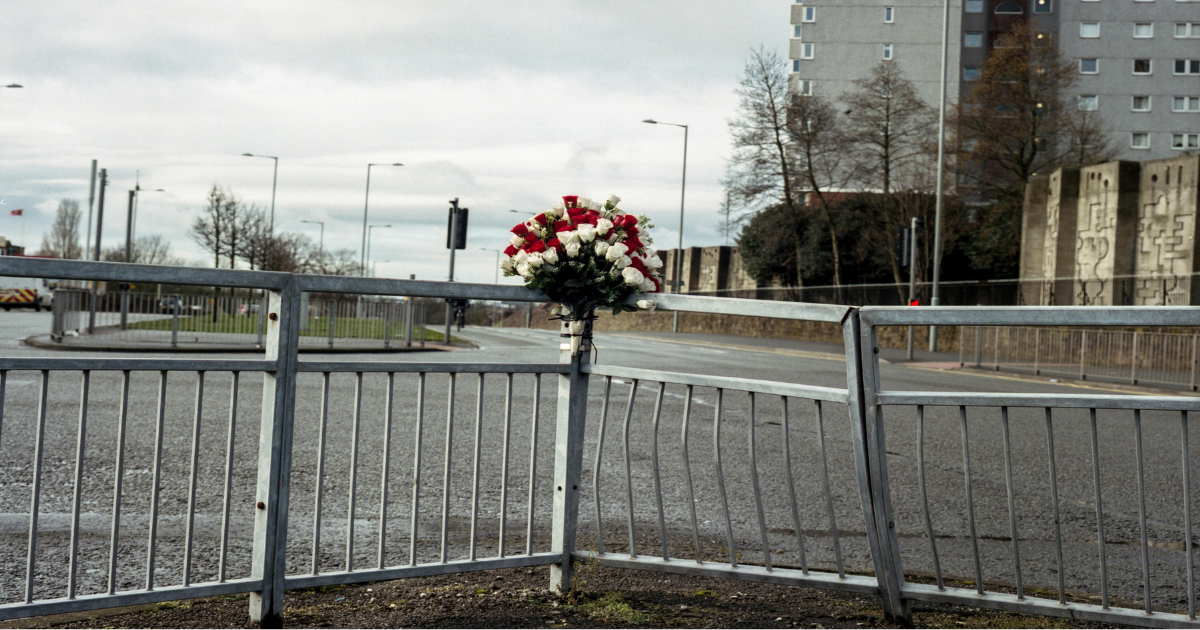
This body of work soon developed into a sustained photographic investigation of roadside shrines. Through a digital lens, Smillie now documents how people construct temporary memorials following sudden death, accident or tragedy, and how these objects exist within everyday public environments.
His images examine not only what is placed at these sites, but also how memorials function socially—how they communicate grief, remembrance and solidarity to strangers passing by.

Photographing the language of roadside memorials
A distinctive aspect of Smillie’s work is his close attention to the material detail of memorial construction.
His photographs reveal:
- memorials attached to trees, lampposts and pedestrian barriers
- professionally arranged florist tributes placed alongside handmade offerings
- waterproof containers protecting cards and candles from the weather
- the use of artificial flowers set against real foliage that often wilts rapidly
Over time, many of the shrines he revisits begin to grow. New items appear on anniversaries, birthdays and significant dates, transforming a small cluster of objects into layered, evolving monuments.
Smillie’s work documents these changes as a slow and emotional process of accumulation—capturing how grief becomes embedded into the physical landscape.
Urban and rural memorials: two very different environments
One of the most striking elements of Smillie’s visual archive is the contrast between memorials located on rural roads and those situated within dense urban environments.
In the countryside, shrines are often positioned beside hedgerows, fences and isolated trees, blending into the surrounding landscape. In the city, however, they exist in far more complex visual and social contexts—framed by high-rise housing, busy pavements, traffic systems and public infrastructure.
By placing these two settings side by side, Smillie highlights how location influences not only the appearance of memorials, but also how they are perceived and negotiated by the surrounding community.

The social and political impact of makeshift memorials
At the heart of Smillie’s practice lies a broader concern with the social and political context of photography and activism through creative work.
Roadside shrines, while deeply personal, occupy shared public space. His photographs explore how this visual presence can provoke powerful and sometimes conflicting responses. For some residents, these memorials become vital sites of remembrance and emotional connection. For others, they can feel intrusive, distressing or inappropriate.
Smillie’s work documents how shrines are:
- objected to by local residents
- periodically removed by authorities or landowners
- debated within communities as either meaningful or disruptive
In doing so, his photography reveals how grief becomes a public experience—negotiated through visual symbols placed directly into everyday environments.
Grief, health and the marking of fatal sites
A particularly sensitive dimension of Smillie’s project examines the emotional and health-related impact of marking the exact location of a death.
By photographing memorials that stand precisely where fatal accidents occurred, his work raises questions about how individuals and families process shock, loss and disbelief. The act of returning to a site, placing flowers or messages, and maintaining a visible shrine becomes part of a wider coping mechanism.
Smillie’s images do not offer answers. Instead, they invite reflection on how societies manage mourning outside of formal spaces such as cemeteries, churches or official monuments.
Shrines through the digital lens
Through the rapid circulation of images online, the roadside memorial now exists simultaneously in physical and digital space. Smillie’s photography captures this dual presence—where a shrine becomes part of a growing visual archive and a shared digital memory.
His work situates roadside shrines within a contemporary photographic practice that is not only documentary, but socially engaged and politically aware. By focusing on the small, fragile and often temporary markers of loss, Graham Smillie offers a quietly powerful visual study of how communities remember, disagree and continue to live alongside grief in public view.

Further reading and resources
More about Graham Smillie
Pro-Camera is a great source for photography equipment.

Pro-Camera
PrincetonX offers a professional photography course that is delivered entirely online and available on demand.

Princeton X online course
52 Assignments: Street Photography is an inspiring and practical guide that encourages you to rethink how you approach street photography. Through a series of creative assignments, the book challenges your visual habits, stimulates your creative thinking, and helps push your photographic practice to a more confident and imaginative level.

Brian Lloyd Duckett
Leave a Reply