
https://pagead2.googlesyndication.com/pagead/js/adsbygoogle.js?client=ca-pub-4000887400212447
In an era when artists increasingly use their practice as a form of political intervention, concept-based practitioner Alison Little has produced a work that refuses quiet contemplation. Convict Blanket, her latest piece of art activism, confronts rape culture and the institutional failures surrounding sexual violence with an unflinching visual language. The work sits at the intersection of craft, protest and social critique—demanding attention not only as an artwork but as a call to action.
If you want to explore these themes further, Guerrilla Girls: The Art of Behaving Badly offers a comprehensive look at the work of the Guerrilla Girls, the influential feminist art collective exposing discrimination and corruption across art, film, politics and popular culture since 1985.

The Art of Behaving Badly
Textile Protest: Craft as Political Language
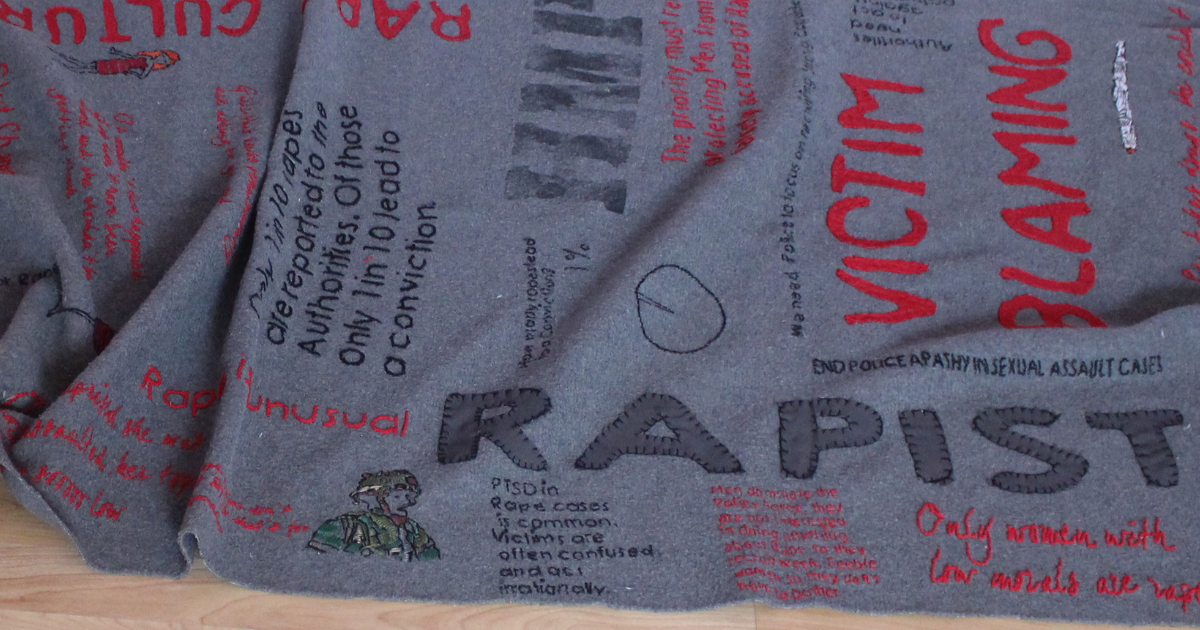
At first glance, Convict Blanket draws on a deceptively humble material: a coarse woollen blanket. The choice is deliberate. Scratchy, utilitarian and evocative of institutional living, the fabric recalls prison bedding and the stripped-back environments of incarceration.
Little uses blanket stitch and appliqué techniques across the surface, methods historically associated with improvised textile protests in prisons—places where detainees reclaim whatever materials they can find to express dissent. In this context, the blanket becomes both medium and metaphor: a site of protest fashioned from the limited resources of confinement.
Placed on the floor and slightly raised along one edge, the artwork encourages viewers to move around it. The embroidered statements and images are positioned along the nearest edge of the textile, allowing the viewer to read them sequentially while circling the piece. The work therefore unfolds physically as well as conceptually; engagement requires movement, reflection and confrontation.
Mercerized Cotton Yarn was used to embroider convict blanket, the strength of the yarn was superior to that of embroidery thread and ideally suited to the project.

Embroidered Voices: Text as Activism
Text dominates the blanket’s surface. Hand-embroidered lettering echoes the aesthetic of marker-pen slogans on protest placards, particularly those scrawled on corrugated cardboard during demonstrations. Little varies scale, case and style to create a hierarchy of voices.
Large, bold statements present definitive claims, while smaller, cursive lines resemble fragments of dialogue or marginalised viewpoints. The contrast gives the impression of a collective conversation—one that oscillates between protest, testimony and critique.
In black thread, the work addresses the question of accountability. Early in the composition appears the familiar UK prison abbreviation “HMP”—Her Majesty’s Prisons. Nearby, the appliqué words “Convict” and “Rapist” form a blunt demand: more perpetrators of sexual violence should be serving custodial sentences.
The central message is unmistakable:
“We must press for the conviction of more rapists.”
By using the second person plural, the text implicates the viewer directly. The demand is not abstract—it calls for collective responsibility.
Many of the thread-manipulation techniques Little used while creating Convict Blanket are explored in the Embroidery – Level 3 Training course offered by Reed Courses.

Statistics and Trauma
Alongside the slogans are references to the psychological and statistical realities of sexual violence. Smaller embroidered statements refer to post-traumatic stress disorder (PTSD), a condition widely experienced by survivors of rape. Visual elements, including the image of a “hide-under” hoodie, hint at behavioural changes and withdrawal often associated with trauma.
The blanket also foregrounds stark figures:
“1 in 10 rapes are reported to the police. Of these, only 1 in 10 lead to a conviction.”
A nearby pie chart distils the message further: only 1% of rapes committed result in a conviction. The statistics underline how sexual violence remains one of the most under-reported crimes, while also pointing to systemic barriers within the justice system.
Little’s black-threaded text repeatedly returns to a central assertion—that responsibility lies unequivocally with the perpetrator. The blanket culminates in a stark declaration: the rapist is “100%” to blame.
The Way We Survive examines the complexities of rape culture in greater depth and serves as a valuable research resource for those wishing to explore the subject further.

Notes on Rape Culture
Red Thread: Naming Rape Culture
If the black text presses for accountability, the red thread exposes the cultural forces that prevent it. Across the blanket, bold appliqué phrases such as “Rape Culture” and “Victim Blaming” punctuate the surface like warning signs.
Here the artwork catalogues familiar accusations directed at survivors: claims about clothing, morality, intoxication or sexual behaviour. References to slut-shaming and the reduction of women to stereotypes such as “the whore” reveal how misogynistic narratives continue to shape public discourse.
Misconceptions surrounding trauma are also challenged. The work notes how PTSD remains poorly understood, and how many still perceive rape as rare rather than endemic. Other statements highlight how alcohol or drug use is often weaponised against survivors, implying consent where none existed.

Alison Little
Institutional Critique
Beyond social attitudes, Little’s textile protest also addresses structural power. The blanket refers to patriarchy and male dominance within institutions, particularly policing and the justice system. Through a series of provocative statements, the work questions whether authorities adequately prioritise sexual violence investigations.
The piece suggests that institutional culture—whether through apathy, bias or misunderstanding—can compound the trauma of survivors. By embroidering these critiques directly into the fabric, Little transforms the blanket into a kind of documentary surface: a record of accusations, frustrations and demands for reform.

Alison Little
The Silence of Self-Blame
Perhaps the most devastating line appears almost quietly among the larger statements:
“It was my fault I was raped.”
The sentence captures the internalised guilt many survivors experience—a factor that contributes to the under-reporting of sexual violence. By including this voice alongside the louder political slogans, Little acknowledges the psychological aftermath that statistics alone cannot convey.
The Art of Activism: Your All‑Purpose Guide to Making the Impossible Possible offers insight into how creative practice can inspire activism and help drive meaningful social change.

Steve Duncombe and Steve Lambert
Art Activism in the Age of Reckoning
Convict Blanket belongs to a growing tradition of art activism that seeks to challenge cultural narratives and institutional inertia. Rather than presenting rape as an abstract issue, Alison Little uses the tactile immediacy of textiles to confront viewers with the lived realities surrounding sexual violence.
The work’s power lies in its contradictions: soft fabric carrying hard truths, domestic craft used as a tool of protest, and a blanket—typically associated with comfort—transformed into a platform for confrontation.
Ultimately, Convict Blanket asks its audience to move beyond passive observation. By circling the work, reading its statements and confronting its statistics, viewers are drawn into the activism embedded within the cloth.
The message stitched through every thread is clear: accountability, cultural change and justice are not optional. They are collective responsibilities.

Alison Little
This article contains affiliate links, which means I may earn a small commission if you click through and make a purchase — at no extra cost to you.
Leave a Reply