
https://pagead2.googlesyndication.com/pagead/js/adsbygoogle.js?client=ca-pub-4000887400212447
The Liverpool Loop Line is easy to miss. A century ago it was a short‑lived railway experiment; today it is a half‑buried keloid scar running quietly beneath the city’s surface. What remains — fragments of track, long tunnels, a no longer functioning station building — is neither destination nor attraction. It is a corridor, a shortcut, a place people pass through on their way to somewhere else.
Yet this overlooked stretch of infrastructure has become one of Liverpool’s most revealing cultural barometers. A century after the last train passed through, the Loop Line has evolved into a contested landscape where fear, belonging, politics and creativity collide. It is a green corridor, a site of far‑right signalling, a canvas for young artists, and a repository for the city’s unspoken tensions.
And increasingly, it is a place where graffiti — raw, urgent, unfiltered — tells the stories the city does not always say aloud.
Looking to bring bold, street-style art into your own space? The Faber-Castell dual-tip graffiti marker set has everything you need to get started. Work on paper and display in a box frame.

Graffiti Colour Set
A Hidden Line with a Heavy History
The Loop Line’s reputation has long been shaped by neglect. For decades it has been associated with dumped weapons, drug paraphernalia and the uneasy sense that this is a place where you keep your head down and walk quickly. As one local resident put it, “You don’t come here to linger.”
Yet the same marginality that makes the route feel unsafe has also made it fertile ground for other forms of life. The overgrown edges now support a rare urban habitat, a thin but vital strip of biodiversity threading through dense housing. And on the walls, bridges and underpasses, another ecosystem has taken route: graffiti.
Here, the city’s anxieties and aspirations are sprayed in colour. The Loop Line has become a visual archive of Liverpool’s shifting identity — a place where young artists claim space, where political messages flare and fade, and where the city’s footballing loyalties, cultural divides and global solidarities are written directly onto brick and concrete.

Graffiti Mural
The Blue Liver Bird: Football Rivalry as Urban Mythmaking
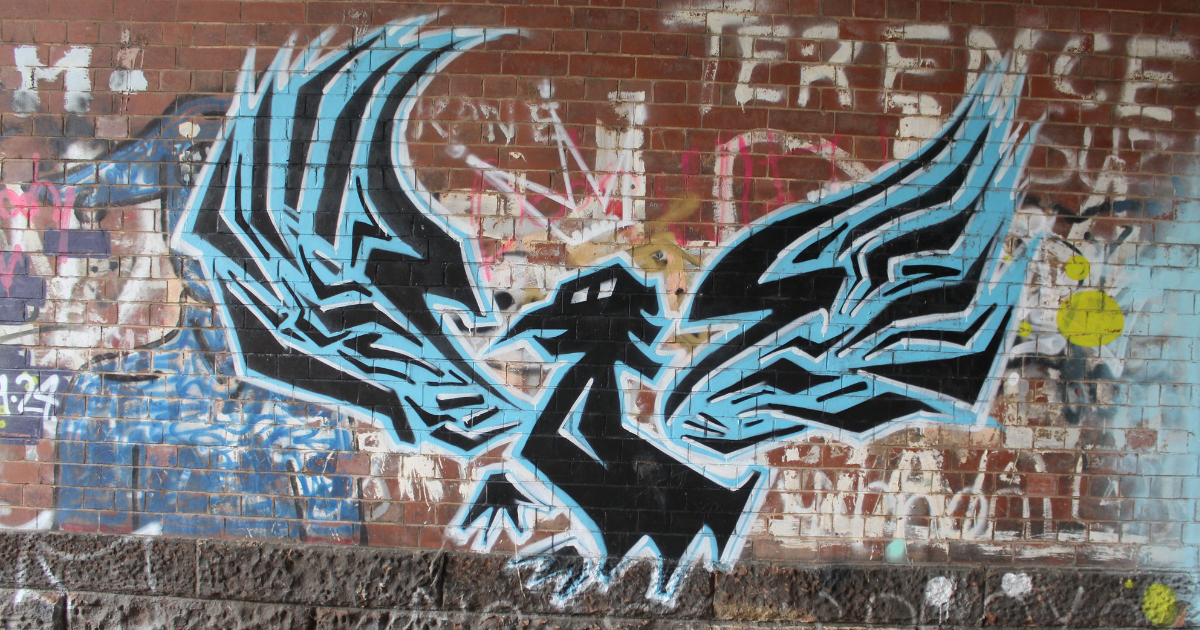
One of the most striking works on the route is a large blue bird painted beneath a bridge — a stylised, symmetrical creature with sweeping wings and sharp, graphic edges. At first glance, it resembles a Liver Bird, the emblem long associated with Liverpool FC. But here it is rendered in Everton blue.
The symbolism is unmistakable. As the document notes, “Blue, of course, is strongly associated with Everton… a clear territorial marker connected to the city’s two great Premier League football clubs.” The Loop Line becomes a stage for a rivalry that has shaped Liverpool’s identity for generations.
But the timing is significant. With Everton’s new Hill Dickinson Stadium rising on the docks, the club’s long‑dormant sense of momentum has returned. The blue Liver Bird reads as a declaration: Everton is stepping out of Liverpool’s shadow.
The piece also carries a mythic undertone. The wings flare like a phoenix, “rising from the ashes” of Goodison Park’s fading legacy. It is both a claim and a prophecy — a visual assertion of renewal in a city where football is never just sport.

Graffiti Mural
The Bull: Cartoon Energy in a Marginal Space
Further along the route, beneath a small bridge, another mural pulses with kinetic energy. A red, bull‑like head charges forward, its horns cutting through swirling lines of motion. Behind it, a blue humanoid figure trails an arm, fingers splayed, as if caught in the slipstream.
The two halves — red and blue — feel like characters in dialogue, or conflict, or uneasy partnership. Their cartoon faces express fear, reassurance, tension. The mural is playful, but also emotionally charged.
What makes this piece compelling is its location. Painted on a curved concrete wall in a semi‑hidden culvert, it transforms a damp, low‑traffic space into a moment of surprise. As the document observes, this is “a non‑representational urban space… particularly open to informal visual intervention.”
Here, graffiti is not vandalism but animation — a way of giving personality to a place the city has forgotten.

Graffiti
“Free Palestine”: Global Conflict on a Local Wall
Not all Loop Line graffiti is playful. On a rough stone retaining wall, the words “Free PALESTINE” appear in red spray paint, haloed in yellow. The letters are uneven, the surface porous, the message unmistakable.
This is graffiti as political intervention — a local expression of a global conflict. The document captures the tension well: the phrase is “either a call for freedom, dignity, and self‑determination… or language that risks legitimising extremist violence,” depending on the viewer’s perspective.
Placed in a wooded, semi‑rural section of the route, the slogan feels both intimate and exposed. It is not part of a dense urban palimpsest but a lone declaration on a natural stone wall. The effect is stark. The Loop Line becomes a conduit between Liverpool and the world, a place where international crises seep into local space.

Free PALESTINE Graffiti
A Landscape of Extremism and Resistance
The Loop Line is not politically neutral. Union Jacks appear along the route — not as patriotic symbols, but as markers of far‑right ideology. These flags “are a mark of Tommy Robinson’s Britain and right-wing extremism.”
Placed alongside anti‑racist and pro‑Palestinian messages, the result is a visual battleground. The walls become a site of persuasion, resistance and counter‑resistance. The Loop Line is not curated, but it is contested.
This is what makes the graffiti so revealing: it shows the city’s fractures in real time.

Railway Bridge
Graffiti as Material, Spatial and Social Practice
Across the three works — the Liver Bird, the Bull, and “Free Palestine” — a set of shared themes emerges that reveals how graffiti functions materially, spatially and socially along the Loop Line.
The first is the nature of the Loop Line itself. Its tunnels, bridges and retaining walls form a marginal, permissive environment: places that are neither fully public nor fully private, and which have become “unofficial cultural zones” where unsanctioned work is tolerated even when technically illegal. This liminal quality shapes everything that appears there.
Another recurring thread is anonymity. Most of the pieces are unsigned, which shifts attention away from individual authorship and towards the collective act of marking space. The absence of a name becomes part of the message, reinforcing graffiti as a shared urban practice rather than a vehicle for personal branding.
Materiality also plays a crucial role. Brick, concrete and stone are not passive surfaces; they actively shape the appearance and meaning of each work. The texture of the wall, its dampness, its age and its imperfections all become part of the visual language. The Loop Line’s surfaces speak back.
Time is equally important. Nothing here is permanent. Graffiti is layered, weathered, overwritten and eroded. Each piece exists only temporarily before being replaced or reclaimed by the environment. The Loop Line becomes a living archive, constantly shifting and accumulating traces of past interventions.
Finally, the works participate in a global visual vocabulary. Whether through cartoon‑like characters, stylised symbols or political slogans, the graffiti connects Liverpool to international street‑art networks and global protest cultures. The Loop Line becomes a local expression of worldwide conversations.
Together, these themes show that graffiti on the Loop Line is far more than decoration or defacement. It is a dynamic practice shaped by place, material, anonymity, time and global cultural exchange — a constantly evolving dialogue written onto the city’s forgotten edges.

Liverpool Loop Line
What the Loop Line Really Shows Us
The Loop Line is not a gallery. It is not curated, funded or protected. It is a place where the city’s subconscious leaks through the cracks.
The graffiti here is not simply decoration. It is:
- a claim to space
- a protest
- a warning
- a celebration
- a conversation
- a conflict
- a form of care
- a form of defiance
Each piece “reclaims a neglected underpass wall and temporarily transforms it into a site of visual power, visibility and urban expression.”
In a city shaped by migration, inequality, football, activism and reinvention, the Loop Line has become an accidental barometer — a place where Liverpool’s competing identities are written, erased and rewritten.
It is, in its own way, the city’s most honest gallery.

Loop Line
Further Resources on Street Art and Urban Culture
Rafael Schacter’s Monumental Graffiti informed much of the thinking behind this article. If you’re interested in exploring these ideas in greater depth, it’s an excellent place to begin.

Rafael Schacter
The Shoreditch Street Art Tour offers valuable insight into how graffiti and street art are created in the nation’s capital. The understanding gained there can easily be carried across the country and applied to other urban contexts.

If you’re looking for music that matches the mood of this article, Ed Sheeran’s album = on vinyl is a great fit — it even includes the track ‘Overpass Graffiti.

Ed Sheeran
The photographs throughout the article where taken with equipment from Love Tech Hate Waste.

Love Tech Hate Waste
This article contains affiliate links, which means I may earn a small commission if you click through and make a purchase — at no extra cost to you.
Leave a Reply