
https://pagead2.googlesyndication.com/pagead/js/adsbygoogle.js?client=ca-pub-4000887400212447
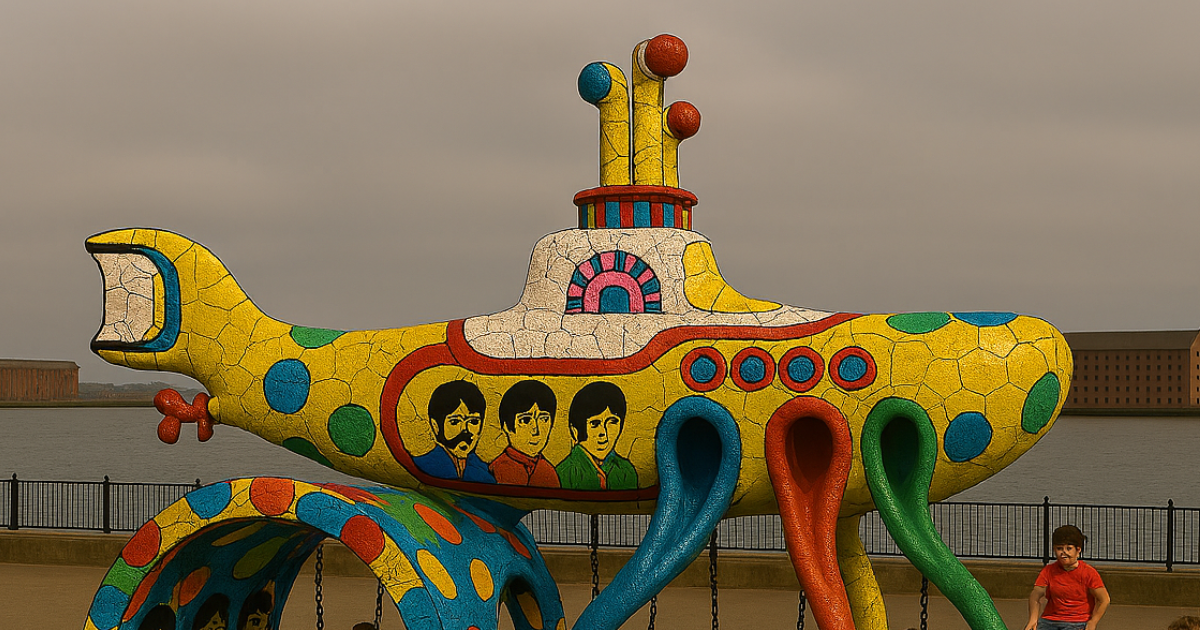
Liverpool is a city shaped by imagination, music, and social creativity. From The Beatles to ambitious regeneration projects, it has long fused culture with everyday life. One compelling idea now worth serious consideration is whether Liverpool could create a Yellow Submarine–inspired art play park—a place where public art, sustainable design, and storytelling come together for both local communities and visitors.
To understand what’s possible, we can look to global precedents where art, play, and resilience intersect.

Literary and Artistic Roots: From Gulliver to Alice
Gulliver Park – Valencia, Spain
In Valencia, Gulliver Park transforms Jonathan Swift’s Gulliver’s Travels into a monumental playscape. A giant Gulliver lies stretched across the park while children climb his limbs, slide down his body, and explore the story physically. It’s a powerful example of how literature can become immersive, inclusive public space.
Alice in Wonderland: From Daresbury to Kyiv
Lewis Carroll, author of Alice’s Adventures in Wonderland, spent much of his childhood in Daresbury, Cheshire, just outside Liverpool. The landscapes of the Mersey region and rural Cheshire are widely believed to have influenced the dreamlike logic and surreal imagery of Alice’s world. This gives Liverpool and its surrounding areas a genuine literary connection to one of the most influential fantasy works in history.
That connection echoes powerfully in Landscape Alley (Peyzazhna Aleya) in Kyiv, Ukraine—a public art and play space inspired by Alice in Wonderland. Designed with whimsical mosaics, sculptural creatures, and interactive forms, it has long been a beloved playground for children and families.
Landscape Alley and War: Play as Resilience
While Landscape Alley has not been a primary military target, it has nevertheless been affected by the war in Ukraine. According to multiple reports from 2022–2025, the area has suffered:
- Damage from nearby missile strikes, particularly those impacting adjacent areas such as Shevchenko Park
- Ongoing wear, disrepair, and reduced maintenance due to wartime pressures
- A decline in overall appeal and visitor numbers
Yet, despite this, children continue to play there. Some who began playing at Landscape Alley when Russia first invaded have now outgrown the playscape. This persistence has turned the park into something more than a playground—it has become a symbol of hope, continuity, and everyday life continuing amid conflict.
For Liverpool, this is a reminder that play parks are not trivial amenities. They can become emotional anchors for communities.
Monster Slides and Bold Art: Niki de Saint Phalle’s Golem
In Jerusalem, Niki de Saint Phalle’s Golem demonstrates another model of artistic play. Children enter slides through the mouth of a brightly coloured monster sculpture, blending slight menace with humour and joy. It proves that public art doesn’t have to be passive—it can be climbed, entered, and experienced.
Want to re-create a Niki de Saint Phalle playscape at home? Zonky do some great ranges to get you started.

Sustainable Inspiration: Scrap Tyre Play Parks in Africa
A crucial question for any contemporary project is material choice. In today’s climate-conscious culture, fibreglass sculptures may no longer be the right answer.
Across parts of Africa, innovative play parks have been created almost entirely from scrap tyres, discarded timber, and reused materials. These spaces are:
- Extremely durable and safe
- Low-cost and community-built
- Environmentally responsible
- Rich in creativity and tactile play
Tyres are stacked, buried, woven, and sculpted to form climbing towers, tunnels, seating, and soft-impact surfaces. These parks show that sustainability doesn’t limit imagination—it can expand it.
A Liverpool Yellow Submarine play park could draw directly from this approach, combining bold artistic vision with recycled, long-lasting materials.
Bring home Yellow Submarine in this new paperback picture book edition, beautifully presenting the film’s vibrant visuals and timeless, humorous tale—an ideal purchase for Beatles fans of every generation.

Why a Yellow Submarine Play Park Works for Liverpool
The Beatles’ Yellow Submarine is one of Liverpool’s most globally recognised cultural symbols. A thoughtfully commissioned play park could:
- Celebrate Liverpool’s music heritage in a child-focused, playful way
- Attract international attention for positive cultural reasons
- Serve local families first, while remaining a must-see destination
- Become a landmark comparable to Park Güell in Barcelona
The goal would not be nostalgia alone, but living culture—a place where children physically explore imagination.
Think you know everything there is to know about The Beatles? The Beatles Story reveals rare treasures and surprising facts that even lifelong fans may not have discovered.

Location, Regeneration, and Equity
A potential location could be north of the city, linked to regeneration around Everton Football Club’s new stadium at Bramley-Moore Dock and the wider docklands renewal. Positioned well, the park could:
- Support regeneration without exclusion
- Provide year-round activity beyond match days
- Connect football, music, art, and public life
But key questions must be addressed:
- Should it be free and publicly owned?
- Should funding be offset by the new tourism tax under debate?
- How do we ensure nearby food, kiosks, and activities remain affordable—so a family day out doesn’t mean £20+ just on ice creams?

Performance, Music, and the Future
An outdoor performance space, similar to early proposals for the Everton site, could transform the park into a cultural stage. New bands could perform at the opening ceremony, spotlighting Liverpool’s ongoing music scene—not just its past.
Could Paul McCartney or other cultural figures be involved in commissioning, consultation, or symbolic endorsement? Even limited involvement would amplify global attention while grounding the project in authenticity.
A Liverpool Equivalent of Park Güell?
Barcelona has Gaudí. Liverpool has its own creative spirit. With the right artist or collective, the city could create a fantastical landscape as visually striking as Park Güell, but rooted in play, sustainability, and community rather than tourism alone.
This would not be imitation—it would be Liverpool expressing itself.
Want to know more about Park Güell, The complete works of Gaudi is a great place to start.

Final Reflection
A Yellow Submarine art play park could be:
- A sustainable public artwork
- A community-first regeneration anchor
- A symbol of joy, resilience, and imagination
From Daresbury’s Alice, to Kyiv’s resilience, to African scrap tyre ingenuity, the influences already exist. The question now is whether Liverpool is ready to bring them together—and imagine boldly once again.

This article contains affiliate links, which means I may earn a small commission if you click through and make a purchase — at no extra cost to you.
Leave a Reply