

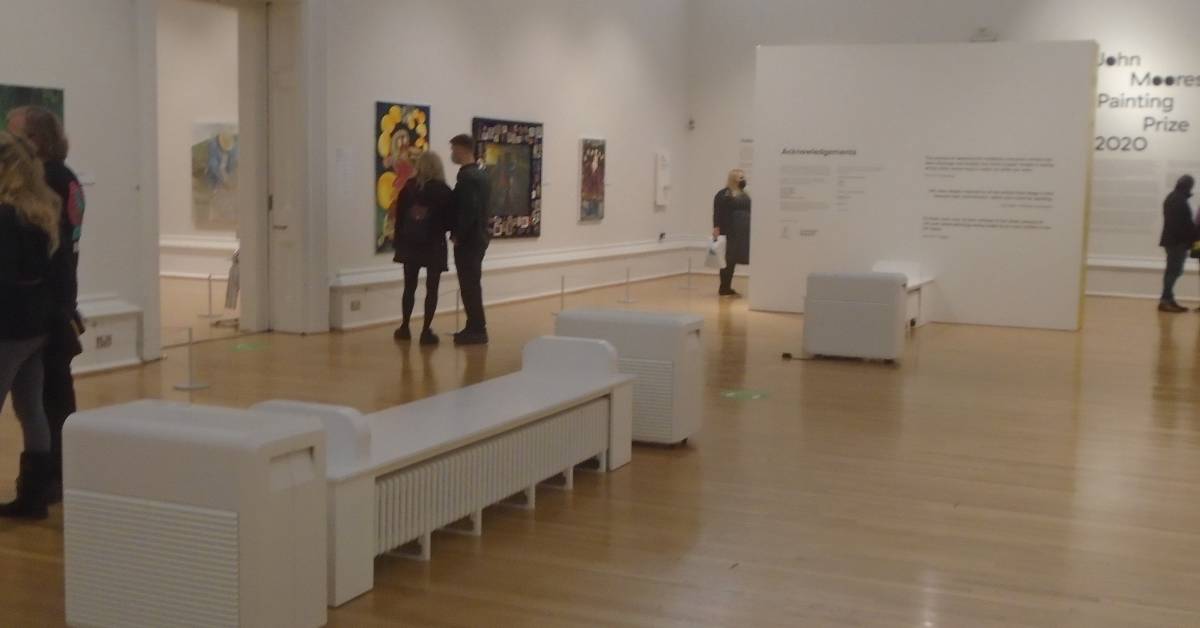
The John Moores painting prize, 2020, delayed by an additional year due to the covid enforced restrictions. The bustling Walker Gallery shows us the cultural draught administered by the pandemic has diminished. Again, we have galleries to visit, exhibitions to experience and the vigour of the John Moores Painting prize in which to resonate.
Chaotic, intense and mind-altering

Robbie Bushe’ The Neanderthal Future Infirmary, a well-deserved scoop onto the shortlist. Chaotic, intense and mind-altering work from the Liverpool born painter. The painting belongs to a series of four and a collaborative animation. Present-day is represented with a hospital setting which appears to drop below ground to the sewers. The vision of a once disused hospital functioning once more. The main goal: to bring back the neanderthal with the extension of saving the human race. Deliberately unsophisticated, the painting technique adds to the chaos of the factory conveyor belt system of the manufacture of life. To a degree, could this vision foreseen BC (Before Covid) relate to the Nightingale hospitals thrown up with haste at the start of the pandemic?
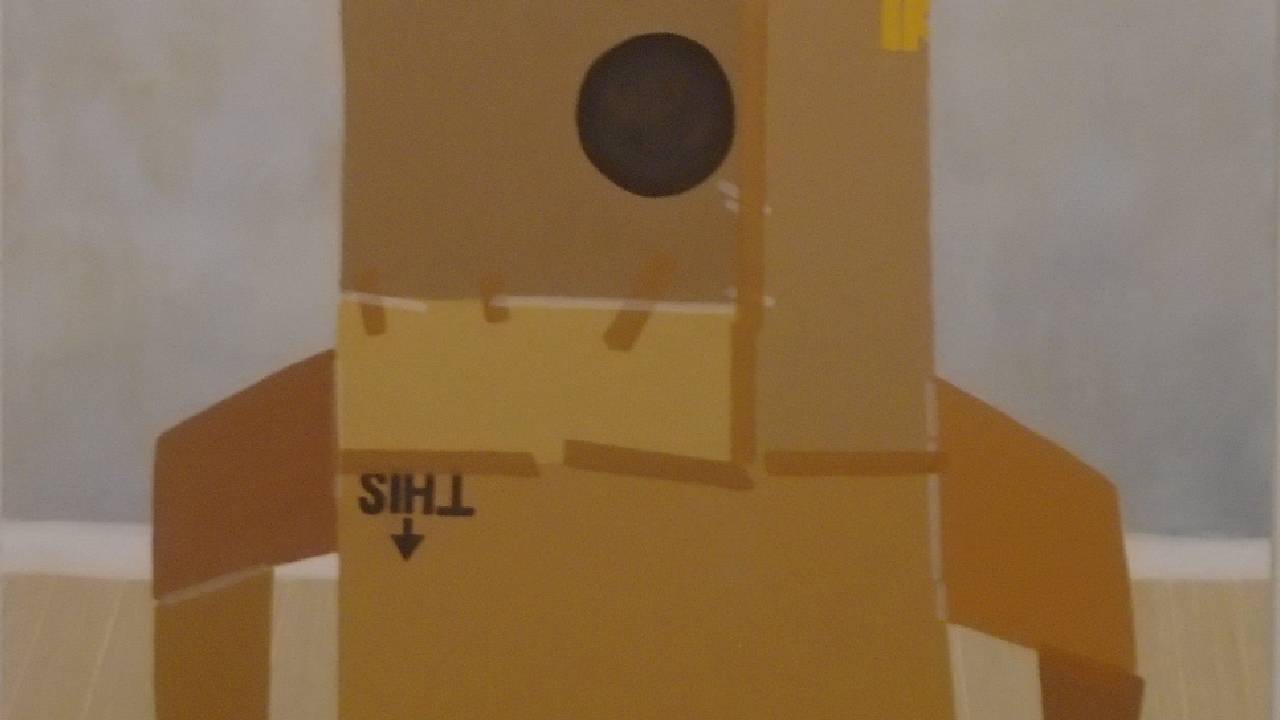
‘To the Moon and Back’ impact appears even more significant as a response to lockdown. Painted pre-pandemic, on first glance appears to be a representation of a lock-down, home schooling project. Arrows pointing in the wrong direction, weight indicators and ‘Fragile’ markings take up surface space on this corrugated cardboard spaceship. Glorious in its lack of symmetry, sublimely tacked together with odd lengths of teeth cut brown tape. The scholastic creation engulfs the interior, standing just short of the light fitting. Most significantly, Fleur Yearsley has captured the desire to escape and break free from the isolation of the home.
a lock-down, homeschooling project
Only in her early thirties, Yearsley is relatively new to the art scene. Born and raised in Manchester, relocated to the Capital in combination with a contemplative period at the Slade. Strong graphical techniques, interiors and the home are commonplace within her works. The canvases most freshly painted replay the realities of lock down; rationing of toilet paper, empty cinemas, the re-emergence of board games and loft ladders leading to the additional spectrum of the domestic domain. Artworks which are oversized and undaunted, but equally precise, a style which is zealous although markedly consecrated. A woman to watch as she creates paintings which literally transport you to newfangled places.
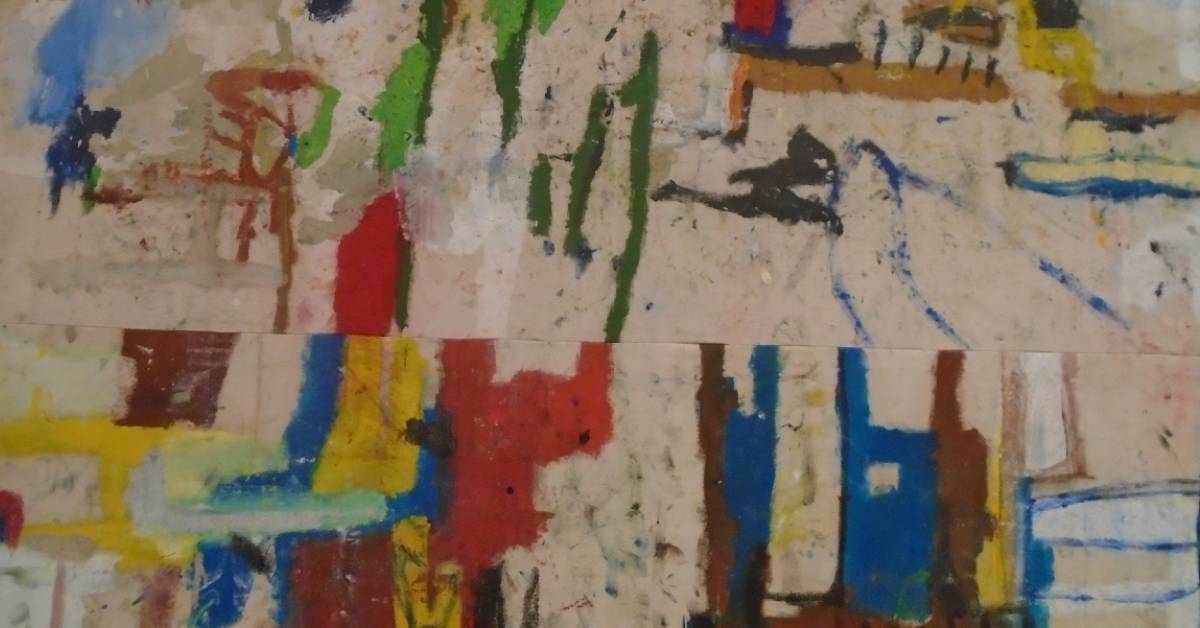
Work from Peter Matthews makes a striking return to the Walker, the artist a former prizewinner from 2018. ‘Summer Sequoia’ draws us to a painter who is quickly becoming Britain’s leading abstract artist. Matthews’ formative years were spent in rural Derbyshire, exploring woodlands, fields and hedgerows, predominantly in isolation. The inland terrain became the oceans of the world in adulthood, however the element of solitude remains unaltered within his practice. Often immersing the canvasses within the salt waters of the sea then utilising the works as protection from the dangers of the wilderness.
‘Summer Sequoia’ was painted as a series along the Pacific Ocean, one part Iwate: Japan, Oregon, USA the second. Produced with oils, acrylics and waste matter, shredded at the sea’s shore, painstakingly restitched then mounted on return to the UK. Through the upper section we are presented with Japan, vertical lignage, tree-like marks, possibly the matsu, commonplace in Iwate. United by the indication of long drawn out shadows created by the extremities of the sun in the East. Contrasted by the lower section from the USA, more compact modular structures, possibly buildings but more probably high scaling rock formations. Additional marks indicating a more sizable population. Summer Sequoia brings joy to the lifting of lockdown, a painting to see and an artist to follow.
Summer Sequoia brings joy to the lifting of lockdown, a painting to see and an artist to follow.
The 2020 prize presents a wealth of variety which the contest brings to the UK’s cultural spectrum. The appearance of traditional folk costumes and the presence of smoking not to be disregarded. Again, that ever pressing contrast between amazement and then questioning ‘Why’s that here?’ as you examine the exhibits.
Is Christopher Handon’s Mother valid, did virtual, as opposed to in-person, viewing lead to the minuscule ‘Standing Stone’ selection? As a contemporary painting prize, why are Edward Sutcliff’ botanical works featured?
More than ever this year reflected the pandemic throughout the works. The desolate moving stairs of commercial shopping centres, wild swimming by moonlight, the pressing concerns around mental health and the concept of escape. Most prominently, the recurring theme of mortality and running through many of the works.
The 2020 John Moores Painting Prize, simply unparalleled.
Booking essential
https://www.liverpoolmuseums.org.uk/jmpp/john-moores-painting-prize
 alisonlittleblog
Leave a comment